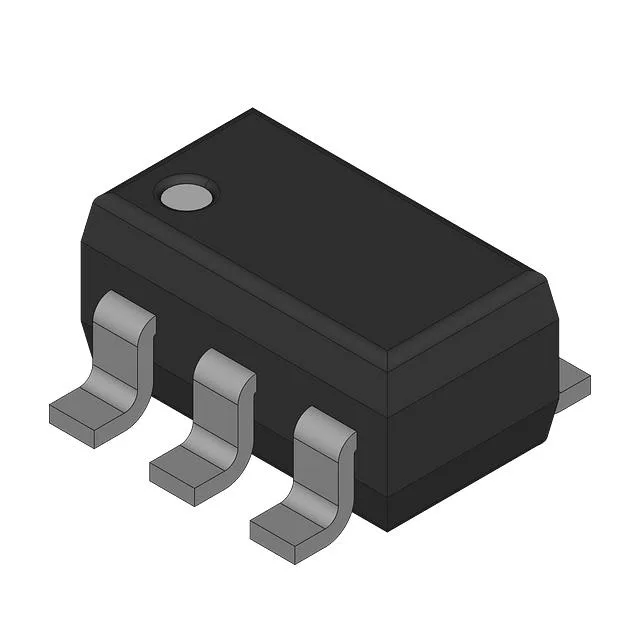
The Maxim MAX917EUK is a single, ultra-low-power comparator that integrates a precision voltage reference on the same die — a combination that saves board space and reduces BOM count in threshold-detection circuits. The device operates from a single supply between 1.8V and 5.5V. Built-in 4mV hysteresis provides clean switching in noisy environments.
The 1.3µA quiescent current is the headline number for battery-life calculations. The 22µs typical propagation delay is adequate for DC and low-frequency threshold detection. The 4mV hysteresis prevents chatter at the trip point, a common failure mode when a comparator sees a slowly ramping signal. Input bias current is a negligible 0.001µA at 5V, so high-impedance sensor dividers won't see loading errors.
Package, Marking, and Provenance
The MAX917EUK comes in a 5-pin SOT-23-5 surface-mount package. The small footprint fits dense two-layer boards. The laser-etched top mark should read the Maxim logo, date-code, and lot trace code.
RoHS compliance is not claimed on this variant — the listing notes RoHS non-compliant status, so designs requiring RoHS compliance should verify the manufacturer's latest material declaration or consider the RoHS-compliant MAX917EUK+ suffix variant.