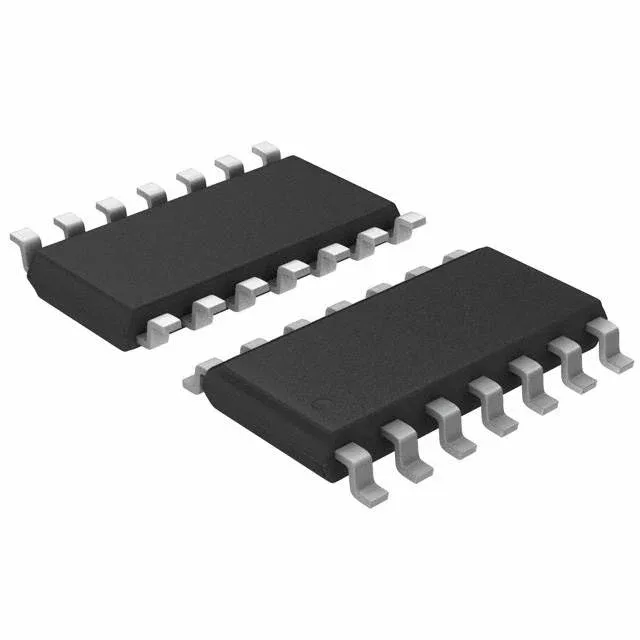
The MAX9034ASD+ is a quad general-purpose comparator from Analog Devices (formerly Maxim Integrated) in a 14-SOIC package. The 2.5 V to 5.5 V single-supply range lets it run directly off a 3.3 V or 5 V rail without a secondary regulator, which simplifies the power tree in mixed-voltage designs. The 228 ns maximum propagation delay sets the timing budget for threshold detection, zero-crossing, and overcurrent/overvoltage fault loops. Quiescent current maxes at 55 µA per package (all four channels active), which keeps the power budget tight in battery-operated equipment like portable instruments, remote sensors, and IoT edge nodes.
Propagation delay (228 ns max) is the spec that decides whether this comparator can close a control loop or flag a fault within your timing budget. For a 100 kHz switching power supply, 228 ns adds about 2.3% of the period — acceptable for overcurrent detection but marginal for cycle-by-cycle peak current limiting. For slower signals like temperature thresholds or battery undervoltage locks, it is more than adequate. Combined with 4 mV of hysteresis, the comparator resists chatter on slowly moving inputs — useful for noisy environments like motor drives or solenoids. The 0.008 µA max input bias current at 5 V means the source impedance can be tens of kilo-ohms without introducing significant offset error. CMRR and PSRR are both 100 dB typical, giving strong rejection of common-mode noise and supply ripple. In a 12 V system divided down to 3.3 V, a 100 mV ripple on the supply translates to roughly 1 µV of referred offset — negligible for most threshold applications.