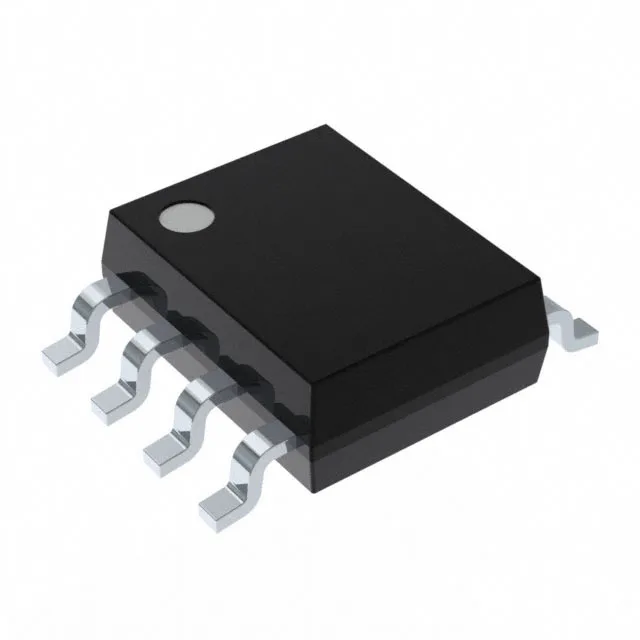
Dual comparator in an 8-SOIC — what you get
It integrates two independent comparators with push-pull, rail-to-rail outputs, so no external pull-up resistor is needed on the output — that saves a component and a trace on the board. Propagation delay is 228 ns max, fast enough for overcurrent detection, zero-crossing, and window comparators in motor drives or power supplies, but not for high-speed ADC clock recovery.
228 ns propagation delay — where it fits
The 228 ns max propagation delay places this comparator in the mid-speed tier. It responds fast enough to catch a fault in a switching power supply loop or to clean up a sensor threshold crossing, but it is not rated for the sub-10 ns edge rates needed in RF or high-speed data paths. For most industrial and automotive threshold-detection jobs — overvoltage lockout, temperature trip, current-limit comparator — 228 ns is more than adequate and the low-power draw is a better trade-off.
55 µA quiescent — power budget friendly
Quiescent current maxes out at 55 µA per the datasheet, which is low for a dual comparator. That matters when the board is battery-powered or thermally constrained — every microamp counts. Input offset voltage is 1 mV max at 5 V, tight enough for precision threshold setting without external trimming.
The 100 dB CMRR and 100 dB PSRR keep the threshold stable even when the supply or common-mode voltage shifts with temperature or load.