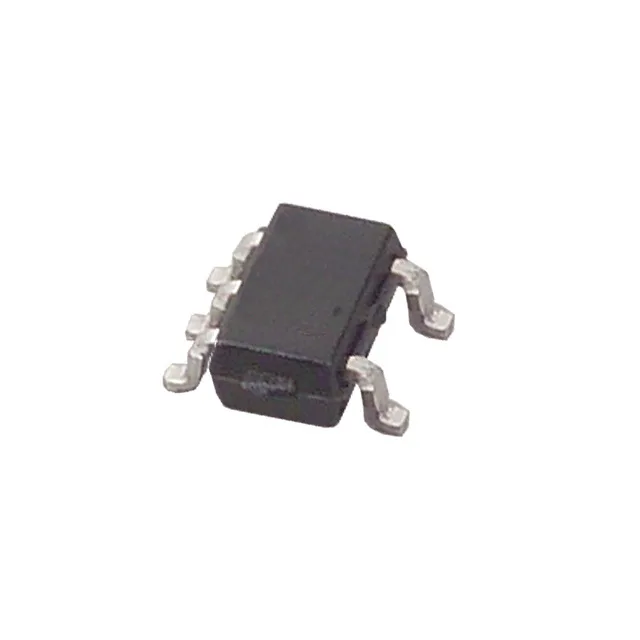
What this comparator brings to the board
The Maxim Integrated MAX9031AXK+T is a single general-purpose comparator in a tiny SC-70-5 package. It delivers push-pull, rail-to-rail output with a 228 ns max propagation delay, drawing only 55 µA quiescent current. The 4 mV internal hysteresis cleans up noisy edges without external feedback resistors. Supply range from 2.5 V to 5.5 V lets it run off a 3.3 V or 5 V rail directly, and the -40°C to 125°C operating range means it can sit in an engine bay or an outdoor sensor pod without a second thought.
A 228 ns max delay is fast enough for most threshold-detection and zero-crossing circuits in motor drives, overcurrent latches, or level translators. It is not a high-speed data comparator — you would not use it for gigabit clock recovery — but for industrial sensor conditioning and power-supply fault detection it leaves plenty of timing margin. The 100 dB CMRR and PSRR keep the threshold stable even when the supply rail bounces or the input common-mode voltage shifts.
55 µA quiescent current — field-friendly power budget
At 55 µA max quiescent, this comparator sips power. In a battery-powered sensor node or a portable instrument, that current is negligible next to the MCU and radio. The input bias current is a mere 0.008 µA at 5 V, so you can use high-value resistive dividers without worrying about offset errors. The 1 mV max input offset voltage is tight enough for precision threshold comparisons — think window comparators or battery undervoltage lockout.
Package and footprint — SC-70-5 is the one to know
The MAX9031AXK+T comes in an SC-70-5 package (also known as SOT-353). If you are prototyping, the Cut Tape (CT) option lets you buy singles; production runs use Tape & Reel (TR). The part is ROHS3 compliant, so no lead-free process headaches.