Comparator with a built-in reference — one less IC on the BOM
The Maxim Integrated MAX9025EBT+T is a single comparator that integrates a voltage reference on-chip, part of the Beyond-the-Rails™ family. This means the comparator threshold is set internally — no external reference IC, no resistor divider string for a trip point. For a window detector, battery undervoltage lockout, or zero-crossing circuit that needs a known threshold, this part collapses what would be a two- or three-chip solution into one 6-bump WLP. The quiescent current maxes out at 2.2 µA, so it can sit on a battery rail monitoring the voltage continuously without draining the pack.
Package reality: 6-WLP is not a breadboard part
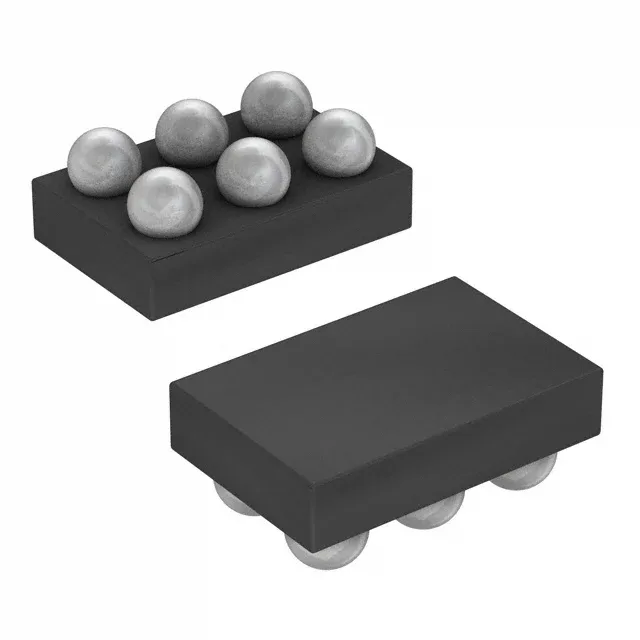
The MAX9025EBT+T comes in a 6-WFBGA / WLBGA wafer-level package, with the supplier device package designated as 6-WLP. The solder bumps are directly on the die — there are no leads, no molded body. This package is tiny and has very low parasitic inductance, which helps the 28 µs propagation delay stay consistent, but it demands a solder-paste stencil designed for WLP and a reflow profile that matches the 6-WLP land pattern. Hand-soldering is not practical; this part is meant for high-volume pick-and-place assembly. That covers most outdoor telecom, automotive cabin, and factory-floor applications, but not under-hood or downhole environments where 125°C is needed.
The output is CMOS push-pull with rail-to-rail swing, capable of sourcing or sinking 50 mA typical. The 4 mV internal hysteresis prevents oscillation near the threshold — useful for slow-moving analog signals like a thermistor voltage or a capacitor ramp. Input offset voltage is specified at 5 mV max at 5 V supply, and input bias current is 0.001 µA max at 5 V. The 50.45 dB CMRR and 60 dB PSRR are adequate for a comparator with internal reference; the reference itself sets the threshold, so supply-induced shifts on the threshold are attenuated by the PSRR of the reference circuit.
Lifecycle and compliance — no end-of-life surprises
ROHS3 compliance is confirmed, so it is fully compatible with lead-free assembly processes and current RoHS directives.