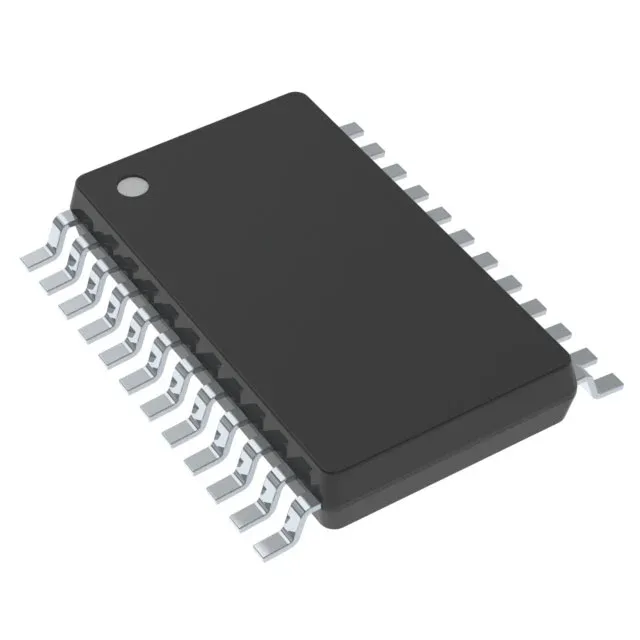
Analog Devices MAX7358EUG+ — Logic ICs

MAX7358EUG+ I²C Multiplexer, 8:1, 24-TSSOP, Active

MPNMAX7358EUG+
End of Life

Analog Devices MAX7358EUG+, 8:1 I²C multiplexer/demultiplexer, 24-ohm max on-state resistance, 2.3V to 5.5V supply, industrial temp -40°C to 85°C, 24-TSSOP package, active lifecycle, ROHS3 compliant.

$6.59Ref. price · indicative, final on quote
Packaging24-TSSOP (0.173", 4.40mm Width)
RoHSROHS3 Compliant
Sourced new & surplus through independent channelsAuthenticity-screened · ESD-safe packingListing updated Aug 2026

Specifications

MAX7358EUG+ specifications
ParameterValue
MountingSurface Mount
Voltage - supply, single (V+)2.3V ~ 5.5V
Operating temperature-40°C ~ 85°C (TA)
PackageTube
FeaturesBi-Directional
ApplicationsI²C
Case24-TSSOP (0.173\", 4.40mm Width)
Channels1
On-State resistance24Ohm
Multiplexer (Demultiplexer circuit)8:1

Product details

8:1 I²C bus multiplexer — 24-ohm on-state resistance

The MAX7358EUG+ from Analog Devices is an 8:1 single-channel I²C multiplexer/demultiplexer in a 24-TSSOP package. It lets one I²C master talk to up to eight downstream buses, each with its own address space and pull-up resistors. The 24-ohm max on-state resistance keeps the bus signal clean and the voltage drop low, even when you are running the bus at 5V and pushing the fan-out.

Supply range and temperature — fits mixed-voltage and industrial gear

Supply voltage spans 2.3V to 5.5V, so it works on a 3.3V or 5V I²C bus without a level shifter.

Bi-directional and surface-mount — field-swappable with care

Marked as bi-directional, so the SDA and SCL lines pass through cleanly in both directions. Surface-mount 24-TSSOP with 0.65mm pitch — you can swap it in the field if you have a hot-air station and a steady hand, but it is not socket-friendly.

Frequently asked questions

How does the MAX7358EUG+ multiplexer work?

It is an 8:1 I²C multiplexer/demultiplexer that connects one upstream I²C bus to one of eight downstream channels. The 24-ohm max on-state resistance minimizes signal degradation, and the bi-directional feature handles both SDA and SCL lines.