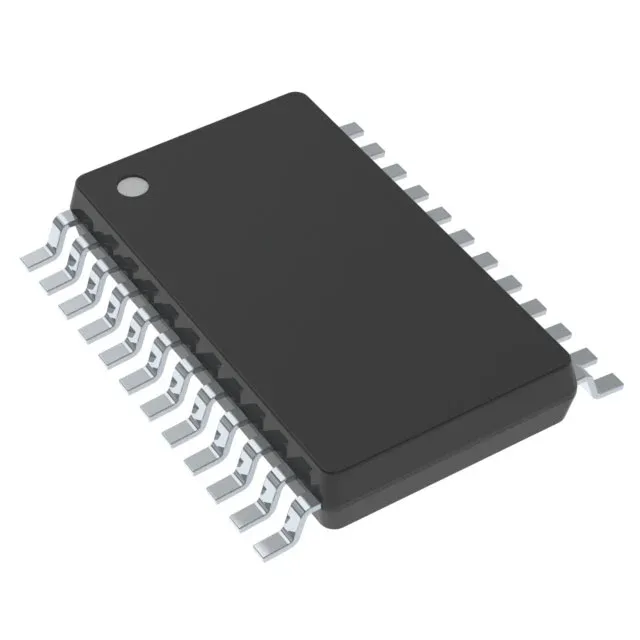
Analog Devices MAX7356EUG+ — Discrete Semiconductors

MAX7356EUG+ Analog Devices 8:1 Mux, 24Ohm, 24-TSSOP

MPNMAX7356EUG+
End of Life

Analog Devices MAX7356EUG+ 8:1 multiplexer/demultiplexer, 24 Ohm on-resistance, 2.3-5.5V single supply, -40 to +85°C, 24-TSSOP, Tube.

$4.79Ref. price · indicative, final on quote
Packaging24-TSSOP (0.173", 4.40mm Width)
RoHSROHS3 Compliant
Sourced new & surplus through independent channelsAuthenticity-screened · ESD-safe packingListing updated Aug 2026

Specifications

MAX7356EUG+ specifications
ParameterValue
MountingSurface Mount
Voltage - supply, single (V+)2.3V ~ 5.5V
Operating temperature-40°C ~ 85°C (TA)
PackageTube
FeaturesBi-Directional
ApplicationsI²C
Case24-TSSOP (0.173\", 4.40mm Width)
Channels1
On-State resistance24Ohm
Multiplexer (Demultiplexer circuit)8:1

Product details

8:1 I²C mux with 24 Ohm series resistance

The MAX7356EUG+ is an 8:1 multiplexer/demultiplexer from Analog Devices, designed for I²C bus expansion. It switches one common I²C channel to any one of eight downstream channels, with a maximum on-resistance of 24 Ohm between the common and selected channel.

On-resistance and signal integrity in the I²C bus

The 24 Ohm max on-resistance adds to the bus pull-up resistance and the trace resistance, increasing the RC time constant of the SDA/SCL lines. For a standard-mode I²C bus (100 kHz) with 4.7 kOhm pull-ups, the extra 24 Ohm is negligible; for fast-mode (400 kHz) with 1.5 kOhm pull-ups, the added resistance still stays under 2% of the total, so timing margin is preserved. The bidirectional feature means the part passes both SDA and SCL signals in both directions without external direction control — the mux handles the bus contention logic internally.

No official successor or pin-compatible cross-reference is listed by Analog Devices — the part is the current design-in choice for this 8:1 I²C mux function.

Frequently asked questions

What does the 24 Ohm on-resistance mean for my I²C bus?

The 24 Ohm max on-resistance adds a small series resistance to the selected channel. For standard 100 kHz I²C with 4.7 kOhm pull-ups, the timing impact is under 1%. For fast-mode 400 kHz with 1.5 kOhm pull-ups, the added resistance is still under 2% of the total, so no pull-up adjustment is typically needed.