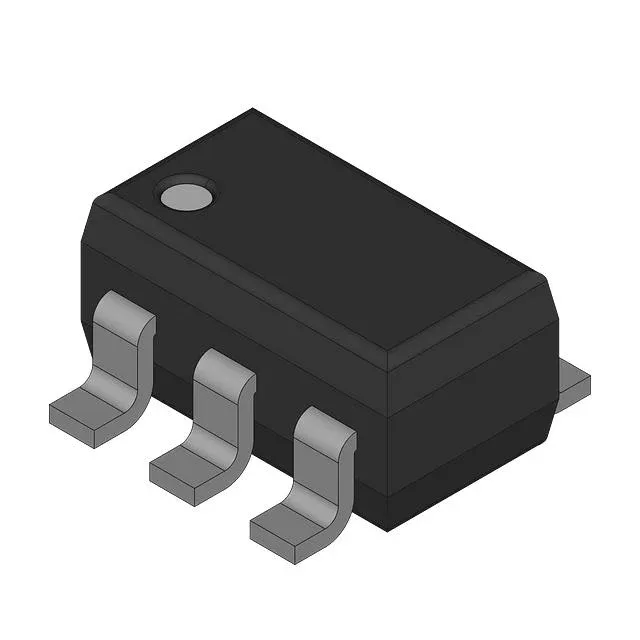
Two-voltage watchdog in a SOT-23-6 footprint
The MAX6715UTVHD3-T is a dual-channel multi-voltage supervisor from Analog Devices, packaged in a SOT-23-6 — six pins on a 2.9 mm × 1.6 mm body, standard 0.95 mm pitch. It monitors two independent supply rails and asserts a single active-low reset output when either falls below its threshold. The two monitored thresholds are 1.313 V and 1.575 V, covering common low-voltage core rails (1.2 V, 1.5 V) plus a margin for brownout detection. Reset timeout is 140 ms minimum — long enough to let all rails settle after a power-up sequence, short enough that the system doesn't linger in reset during a brief glitch.
Note that this part is listed as RoHS non-compliant — it contains lead (Pb) above the 0.1% threshold. For designs requiring RoHS compliance, a lead-free variant or a different supervisor from the same family should be selected.
What the thresholds mean for your rail selection
The 1.313 V threshold is typically used to monitor a 1.2 V core supply — the supervisor asserts reset when the rail drops about 9% below nominal, catching brownouts before logic errors propagate. The 1.575 V threshold suits a 1.5 V or 1.8 V rail; on a 1.8 V supply it triggers at roughly 12.5% below nominal, which is a reasonable trip point for a DDR memory VDDQ rail. Because the reset is active-low and open-drain, the pull-up resistor value sets the rise time into the downstream logic input. A 10 kΩ pull-up to the monitored rail's voltage works for most CMOS inputs; a lower value (4.7 kΩ) speeds the edge if the load capacitance is high. The SOT-23-6 footprint keeps the routing short — the supervisor sits close to the rails it watches, minimising noise pickup on the sense traces.