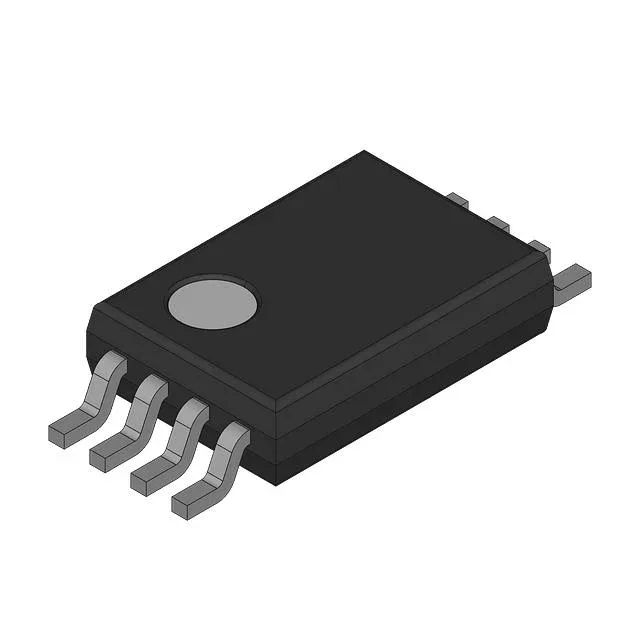
Active production — two-channel supervisor for multi-rail sequencing
The MAX6705AMKA-T is an active-production multi-voltage supervisor from Analog Devices, monitoring two supply rails with a fixed 4.38 V threshold on one channel and an adjustable threshold on the second via external resistor divider. It asserts a push-pull, active-low reset output for a minimum of 140 ms when either monitored voltage falls below its threshold, then releases after the timeout once both rails recover. The -40°C to 125°C operating range suits it for industrial and automotive-adjacent environments where the supervisor must stay reliable across the full thermal profile of the enclosure.
Threshold selection and channel count — the BOM-fit decision
Two monitored channels let a single supervisor cover both the core and I/O rails of a mixed-voltage system, reducing component count versus using two single-channel supervisors. The fixed 4.38 V threshold is intended for a 5 V rail — the nominal trip point sits at roughly 87.6% of 5 V, a typical undervoltage detection level for 5 V logic supplies. The adjustable channel uses a resistor divider from the reference to set the trip voltage, giving flexibility for non-standard rail voltages (3.3 V, 2.5 V, 1.8 V) without needing a different supervisor order code. A 140 ms minimum reset timeout provides enough debounce to ride through brief supply glitches from load transients or hot-plug events without nuisance resets.
SOT-23-8 package and surface-mount assembly
The SOT-23-8 package (supplier device package SOT-23-8) occupies approximately 3 mm × 3 mm of board area, fitting into space-constrained layouts alongside the decoupling capacitors for the monitored rails. Surface-mount assembly is straightforward with standard reflow profiles for the SOT-23 body; the small footprint does not require a thermal pad, simplifying the PCB layout for a supervisor that draws minimal quiescent current.
RoHS non-compliance — regulatory note for BOM review
The MAX6705AMKA-T is marked RoHS non-compliant, meaning it does not meet the EU Restriction of Hazardous Substances directive — this may affect BOM acceptance in markets that require RoHS compliance for new product introductions. For designs that mandate RoHS conformance, a lead-free variant from the same family (check the MAX6705 suffix for Pb-free options) should be evaluated at the BOM review stage.