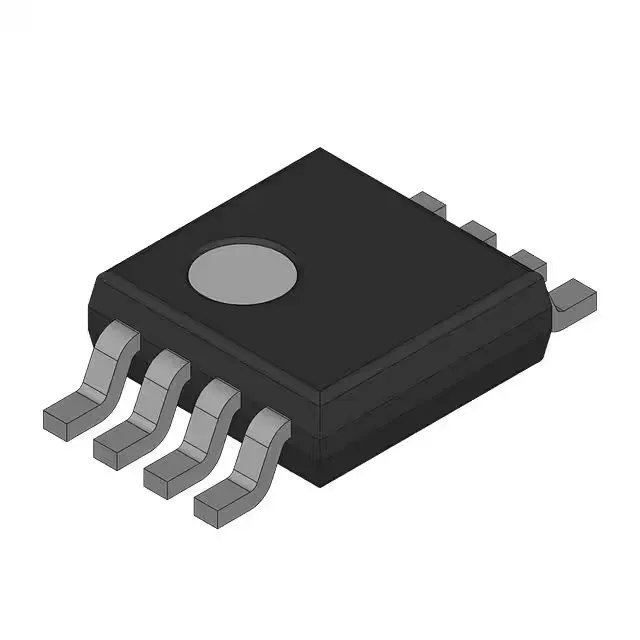
The MAX6646MUA comes in an 8-µMAX package (3.00mm width, 8-TSSOP/8-MSOP footprint) — a small-outline surface-mount package that fits tight layouts and is straightforward to hand-solder or rework with a hot-air station. The Bulk packaging means you get tubes, not tape-and-reel; plan for manual placement or tube-fed pick-and-place if your line is set up for reels.
What the key ratings mean for your BOM
11-bit resolution gives temperature steps of roughly 0.125°C — enough for system thermal management but not for precision metrology. The ±2°C typical (±3°C maximum) accuracy is the spec that matters: it's adequate for fan control, over-temperature alerts, and CPU throttling, but if you need ±0.5°C across the full range, this part isn't the one. The SMBus output ties directly to a PMBus or SMBus host controller without extra level translation. Local sensing covers 0°C to 100°C, the board's ambient range. Remote sensing goes from 60°C to 145°C — that's the range for a CPU core, GPU hotspot, or power FET case temperature. The remote diode is external; the sensor measures the Vbe change of a diode-connected transistor. This part survives cold soak and hot environments like engine bays or outdoor telecom cabinets, but the local sensing range is narrower (0°C to 100°C), so the die itself can be cold while the local channel is out of its specified range.
Where this sensor fits in a system
This is a discrete semiconductor — a digital temperature sensor used in thermal management for CPUs, FPGAs, power modules, and battery packs. The local channel monitors the board ambient; the remote channel monitors a hot component via an external diode. The One-Shot and Shutdown modes let you conserve power between readings, useful in battery-powered or duty-cycled systems.