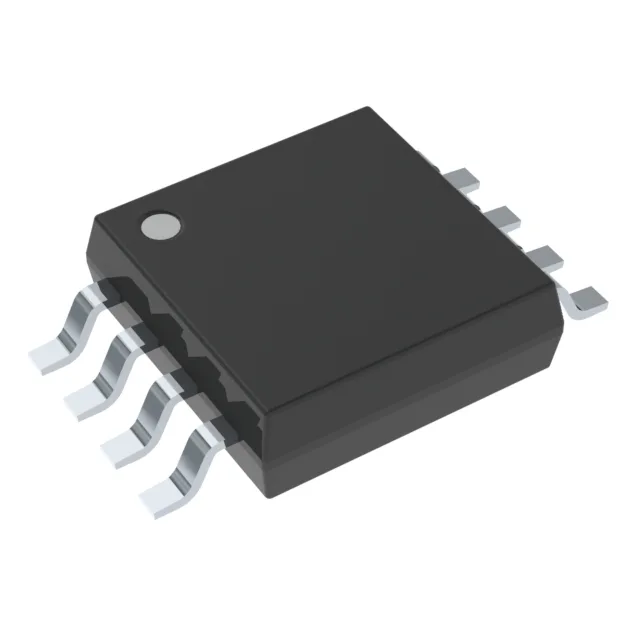
Analog Devices MAX6126B50+ — Circuit Protection

MAX6126B50+ Analog Devices Voltage Reference, 5V Fixed, 0.1%

MPNMAX6126B50+
End of Life

Analog Devices MAX6126B50+ series voltage reference, fixed 5V output, ±0.1% tolerance, 2.85µVp-p noise, 10 mA output, -40°C to 125°C, 8-uMAX/uSOP.

$8.32Ref. price · indicative, final on quote
Packaging8-TSSOP, 8-MSOP (0.118", 3.00mm Width)
RoHSROHS3 Compliant
Sourced new & surplus through independent channelsAuthenticity-screened · ESD-safe packingListing updated Aug 2026

Specifications

MAX6126B50+ specifications
ParameterValue
Output typeFixed
MountingSurface Mount
Reference typeSeries
Voltage - input5.2V ~ 12.6V
Voltage - output (Min (Fixed))5V
Output current10 mA
Current - supply725µA
Operating temperature-40°C ~ 125°C (TA)
PackageTube
Tolerance±0.1%
Case8-TSSOP, 8-MSOP (0.118\", 3.00mm Width)
Noise - 0.1Hz to 10Hz2.85µVp-p
Temperature coefficient12ppm/°C

Product details

Precision 5V anchor for ADC/DAC reference rails

The MAX6126B50+ is a series voltage reference from Analog Devices that delivers a fixed 5V output with ±0.1% initial accuracy and an ultra-low 2.85µVp-p noise from 0.1Hz to 10Hz. This noise floor is low enough to preserve the effective number of bits in a 16-bit SAR ADC without additional filtering — the reference's own noise contribution sits well below the ADC's quantization noise. The 12ppm/°C temperature coefficient means the output drifts less than 1 mV over a 100°C swing, so a precision measurement system holds its calibration across the full industrial temperature range without a trim pot in the reference path.

Supply headroom and load capability

The input voltage range spans 5.2V to 12.6V, giving the designer flexibility to run this reference from a 5.5V regulated rail or a 12V unregulated bus. The 10 mA output current is sufficient to bias the reference input of a single ADC or DAC plus a small resistive divider — but if the load exceeds 10 mA, a buffer amplifier must be inserted between the reference and the load. Quiescent supply current is 725 µA typical, which matters for battery-powered instruments where every microamp counts. The series topology means the load current is drawn from the input, not the output — the reference's own dissipation stays low even at full output current.

Delivery is in Tube format, not tape and reel. If your pick-and-place line requires reel packaging, factor in a tube-to-reel transfer step or confirm with your assembler that tube-fed parts are acceptable for the feeder bank.

Active lifecycle and sourcing posture

No lead-free process change is required for reflow soldering.

Frequently asked questions

Is MAX6126B50+ equivalent to MAX6126A50?

The MAX6126A50 and MAX6126B50+ share the same 5V fixed output and series reference topology, but the A-grade variant carries a tighter initial accuracy specification. The B50+ grade offers ±0.1% tolerance, while the A50 grade is typically ±0.02% or better. Check the specific datasheet tolerance row for the A-grade before substituting — the B50+ is a lower-cost option with relaxed initial accuracy.

What is the maximum output current of MAX6126B50+?

The MAX6126B50+ is rated for 10 mA output current. Exceeding this limit will cause the output voltage to drop out of regulation. For loads above 10 mA, buffer the reference output with an op-amp configured as a unity-gain follower.

Does MAX6126B50+ come in tape and reel packaging?

No, the MAX6126B50+ is supplied in Tube packaging. If your assembly process requires tape and reel, the part must be transferred from tube to reel by your contract manufacturer or a third-party packaging house.