Headline ratings and the headroom they demand
The MAX603CSA+T: Rated for 500 mA continuous output, this LDO delivers enough current for a small microcontroller, a wireless module, or a sensor cluster. Quiescent current is 35 µA typical — low enough that the regulator's own draw does not dominate a battery-powered design's sleep budget. A device that spends most of its time in a low-power state and wakes briefly to transmit or log data will see the regulator's Iq as a minor fraction of the total drain. The output is adjustable from 1.25 V up to 11 V using an external resistor divider, with a fixed 5 V option available by tying the SET pin to ground. The 11.5 V maximum input voltage limits the usable input to a 12 V rail with margin — a 12 V supply at its tolerance high end (say 12.6 V) exceeds the abs-max and needs a pre-regulator or a different part.
Protection set and temperature grade
On-chip protection covers overcurrent, overtemperature, and reverse polarity on the input. The reverse-polarity clamp means the part survives a miswired battery connection without external Schottky diodes — useful in benchtop or field-service scenarios where the power leads get swapped. An industrial or automotive environment with ambient temperatures below freezing or above 70°C calls for the extended-temperature version of the same die.
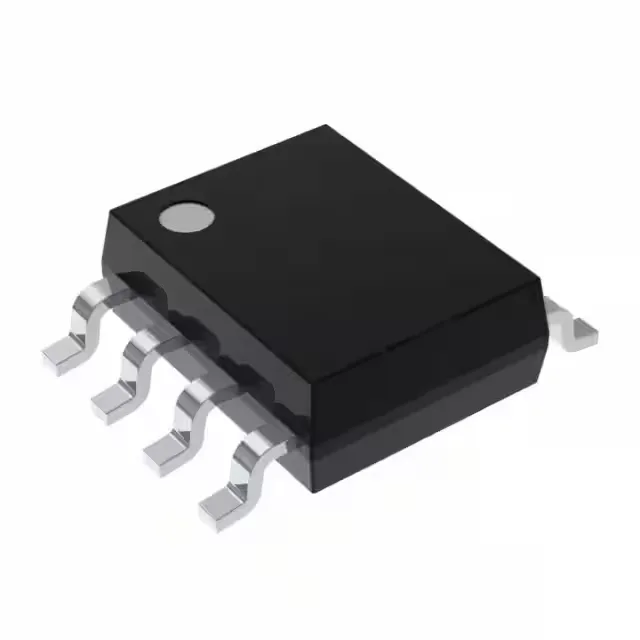
Housed in the standard 8-SOIC package (3.90 mm body width), the MAX603CSA+T uses a footprint shared across hundreds of LDOs and op-amps. The SOIC-8 land pattern is well-documented; the centre paddle is not an exposed pad, so thermal dissipation relies on the copper area on the PCB connected to the GND pins.