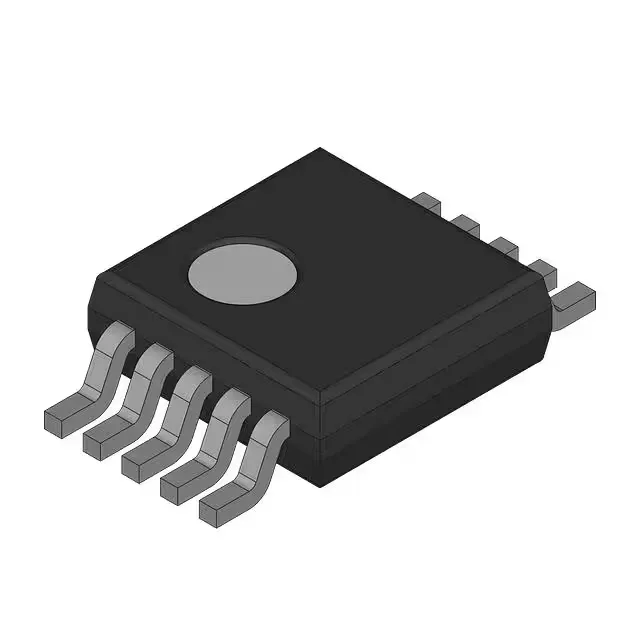
16-bit R-2R DAC with 1 µs settling — the accuracy-speed tradeoff
The MAX5444BCUB is a 16-bit voltage-output digital-to-analog converter built on an R-2R ladder architecture. The ±0.5 LSB INL and DNL specs mean the output lands within half a least-significant bit of the ideal transfer function across all codes — no missing codes guaranteed, which is the baseline for closed-loop control or precision calibration where a single-code error shifts the setpoint by 1/65536 of the reference voltage. Settling time is 1 µs typical to ±0.5 LSB for a full-scale step. For a system updating at 500 kHz, the DAC output has settled within one clock cycle — the bottleneck shifts to the serial interface clock rate and the downstream amplifier's slew rate, not the DAC core.
Supply rails and interface — single-supply simplicity with standard digital back-end
The reference is external (REF pin), so the output full-scale range equals the applied reference voltage up to the supply rail. The unbuffered output means the DAC's output impedance is the R-2R ladder resistance (~5-10 kΩ); driving a low-impedance load or a long trace requires an external op-amp buffer. The digital interface accepts 3-wire serial, SPI, QSPI, and Microwire protocols — the same four-wire bus (SCLK, DIN, CS, and DOUT for daisy-chain) used on most MCU SPI peripherals. The 16-bit word loads MSB-first; the update occurs on the rising edge of CS, so the output holds the previous value until the frame completes.
Package, temperature grade, and compliance flags
Housed in a 10-uMAX (3 mm × 3 mm) package — the same footprint as the 10-TFSOP/MSOP-10. The 0.50 mm pin pitch and 3 mm body width fit a two-layer board with routed traces; the exposed pad (if present on the uMAX variant) aids thermal transfer but is not required for power dissipation at the 0.5 mA typical supply current. The lifecycle status is Active, so no end-of-life or last-time-buy pressure exists for new designs. One compliance caveat: the part is marked RoHS non-compliant, meaning it contains lead in the solder finish or die-attach — verify your BOM's RoHS exemption policy before committing.