Active production — what this means for your BOM
The MAX4833EUT33BD3-T: This 100 mA LDO delivers a fixed 3.3 V output from a maximum input of 5.5 V, with a dropout voltage of just 0.13 V at full load — the headroom between the input rail and 3.3 V must stay above 130 mV across the load range to maintain regulation.
Quiescent current and dropout — the quiet-rail tradeoffs
Quiescent current is 150 µA typical — this LDO draws its own supply current from the input rail regardless of load, so the total system idle power is the sum of Iq and the load current through the pass element. The 0.13 V max dropout at 100 mA means the pass element is a low-Rds(on) PMOS; the dropout voltage increases with load current, so the minimum input-to-output differential must be budgeted at the worst-case load. Protection features include over-current, over-temperature, and reverse-current protection — the reverse-current block prevents back-feed from the output to the input when the input rail collapses, which matters for shared-rail topologies.
Package and board-fit for space-constrained rails
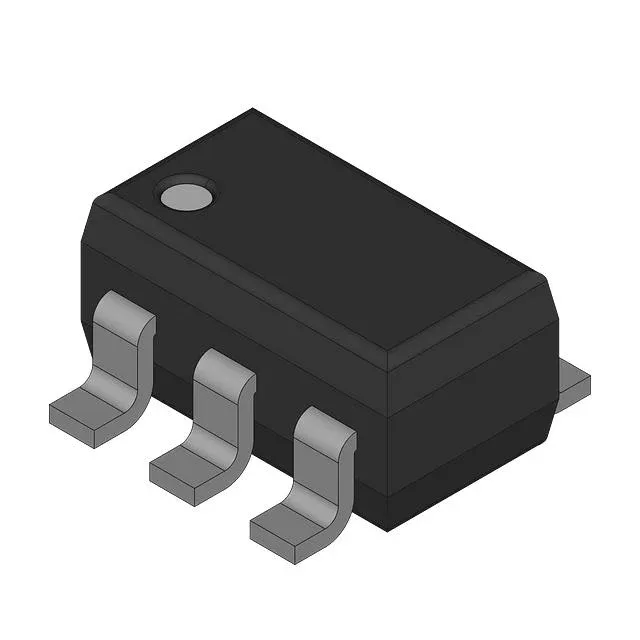
Housed in a SOT-23-6 surface-mount package, the MAX4833EUT33BD3-T occupies a footprint of roughly 2.9 mm × 2.8 mm — the small outline suits dense PCB layouts where a dedicated LDO per sensitive rail is preferred over a shared regulator. Control features include an Enable pin for power sequencing, a Reset output for monitoring the regulated rail, and a Soft Start pin to limit inrush current during startup — these are useful when sequencing multiple rails for an SoC or FPGA.