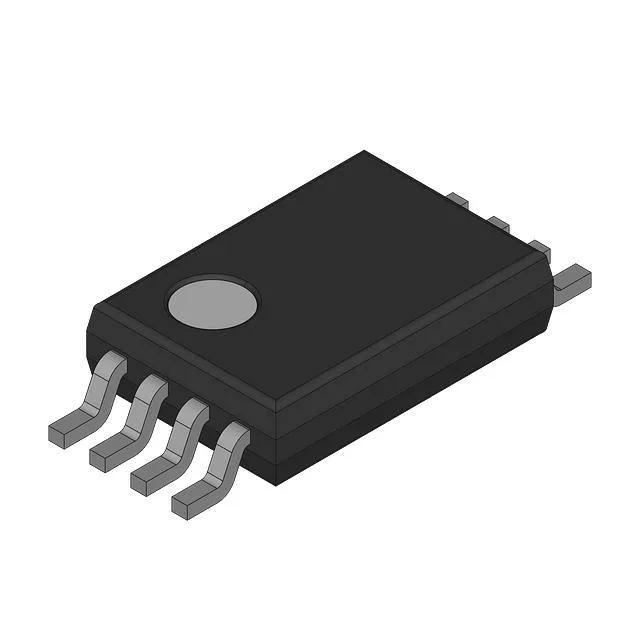
What this SPST-NC switch brings to the signal path
The MAX4657EUA: It switches one channel with a maximum on-resistance of 10 Ohms, flat enough across the signal range to keep audio and low-frequency analog paths clean. The -3 dB bandwidth of 210 MHz means it handles composite video or baseband data without rolling off the edges. Supply flexibility is the standout: it runs from a single 9V to 40V rail or from dual ±4.5V to ±20V supplies. That covers 12V and 24V industrial buses, battery stacks, and split-rail audio supplies without a secondary regulator. Charge injection is specified at 23 pC, which matters when the switch feeds a sample-and-hold or a high-impedance ADC input — the injected charge can shift the held voltage if the downstream capacitance is small. The 1 nA max off-leakage keeps the signal path from loading the source when the switch is open.
A 10 Ohm series resistance in a 10 kOhm load creates a 0.1% voltage divider error — negligible for most precision analog paths. Into a 600 Ohm audio load the loss is about 1.6%, still acceptable for line-level signals. The real constraint is the switch's current capability: the 10 Ohm channel and the package's thermal limit together set the maximum continuous current. For DC or low-frequency switching, derate the current so the I²R drop stays within the package dissipation.
Switching speed and timing margin
Turn-on time is 200 ns max, turn-off is 100 ns max.
The 8-µMAX package (3.00 mm x 3.00 mm body, 0.65 mm pitch) is a space-saving surface-mount option. The same footprint covers the 8-TSSOP and 8-MSOP variants, so a single PCB layout works across the family. Not rated for under-hood or extended military temperature, but fine for the vast majority of commercial and industrial designs.