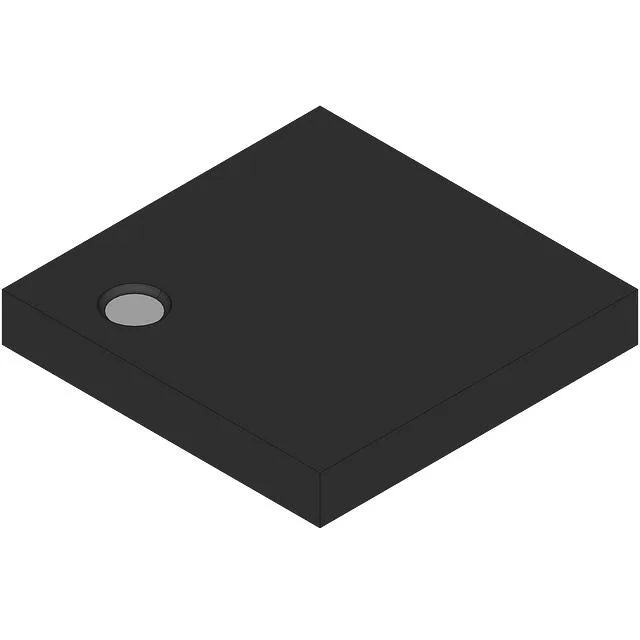
Quad SPST with -90 dB crosstalk floor
The MAX4523EGE packs four SPST switches — two normally-open, two normally-closed — in a 16-QFN (4x4 mm) package with an exposed pad for thermal management. Each switch handles rail-to-rail analog signals across a single supply from 2 V to 12 V, or a dual supply of ±2 V to ±6 V. The -90 dB crosstalk spec at 100 kHz means adjacent channels stay isolated by a factor of roughly 30,000 — a multiplexed data-acquisition front end won't see bleed from the neighboring channel into the settling band.
Switching speed and charge injection
Turn-on time is 80 ns max, turn-off 30 ns max — the asymmetry means the break-before-make window is about 50 ns, enough to prevent shoot-through in a sample-and-hold or gain-switching application where the downstream op-amp expects a clean open before the new path closes. Charge injection is 1 pC typical — that 1 pC dumped into a 10 pF sampling cap gives a 100 mV glitch, so keep the hold capacitance above 100 pF if the downstream ADC has a 1 LSB budget at 16 bits and 5 V reference.
On-resistance and channel matching
On-resistance is 100 Ohm max with channel-to-channel matching of 1 Ohm — the 1 % spread means the voltage drop across each switch leg tracks closely, important for a precision attenuator or a programmable-gain amplifier where the gain-setting resistor is the switch itself. Leakage current is 1 nA max off-state, and the off-capacitance per channel is 2 pF — together they limit the off-isolation at high frequencies, but for DC-coupled signals under 1 MHz the leakage term dominates the error budget.
Temperature range and package
The 16-VQFN exposed pad (4x4 mm) needs a thermal via array under the paddle to pull heat into the PCB ground plane — without it the die temperature rise from the on-resistance self-heating cuts into the 85°C ceiling.