What this op-amp brings to the board
Typical applications include high-speed signal conditioning, video line drivers, ADC input buffers, and portable instrumentation where board area and power budget are tight.
A slew rate of 240 V/µs lets this op-amp reproduce fast edges without significant distortion. For a 5 V peak-to-peak output swing, the full-power bandwidth is roughly 7.6 MHz — enough to handle composite video, high-speed DAC reconstruction, or pulsed sensor signals. The 80 MHz -3 dB bandwidth supports closed-loop gains of 10 or more while maintaining useful loop gain at lower frequencies. The 620 µA supply current is unusually low for this speed class. In a battery-powered design, that ratio — 240 V/µs per 620 µA — translates to less thermal dissipation and longer runtime compared to older high-speed op-amps that might pull 2–3 mA for similar slew rates.
Rail-to-rail output and drive capability
The rail-to-rail output swings within about 50 mV of each rail under light load, preserving headroom in low-voltage single-supply systems.
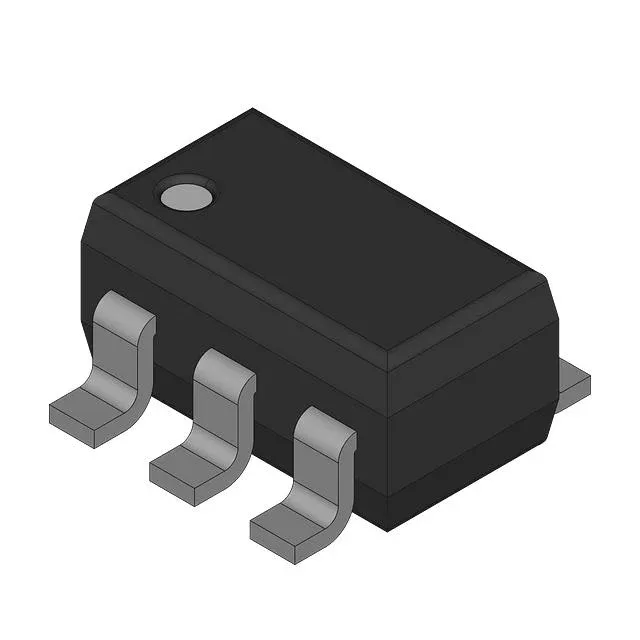
The MAX4352EUK is supplied in a SOT-23-5 (SC-74A) surface-mount package. No special layout rules beyond the usual bypass capacitor within a few millimetres of the supply pins.
It is RoHS non-compliant — verify your assembly's RoHS exemption or plan for a leaded-solder process.