It operates from a 2.4 V to 6.5 V supply span and draws 725 µA per channel, making it suited for battery-powered or low-voltage industrial signal conditioning, sensor buffering, and active filter stages where a moderate bandwidth and low power are needed.
The 5 MHz gain-bandwidth product sets the usable small-signal frequency range; for a closed-loop gain of 10, expect a -3 dB bandwidth around 500 kHz. The 2 V/µs slew rate limits large-signal output swing at higher frequencies — a 5 V peak-to-peak step slews in about 2.5 µs, so full-power bandwidth is roughly 160 kHz. The 1.2 mV input offset voltage (max) and 50 nA input bias current are typical for a general-purpose bipolar input stage; for precision DC applications, a lower-offset op-amp would be preferred. Rail-to-rail output swing helps maximize dynamic range in low-voltage single-supply designs.
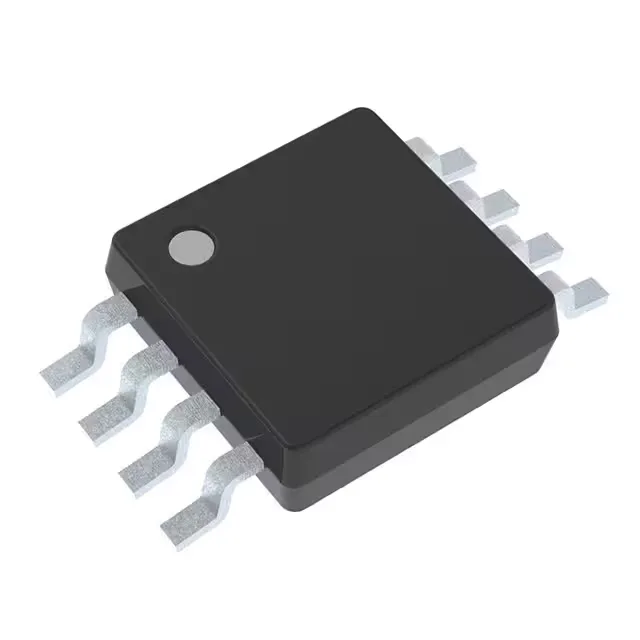
The 8-µMAX (MSOP-8) package has a 3.00 mm body width and 0.65 mm pin pitch, sharing the same footprint as the 8-TSSOP variant. Surface-mount only; no through-hole option exists.