These two specs together define the usable signal bandwidth: the 2 MHz GBP tells you the gain you can get at a given frequency (e.g., gain of 10 gives a 200 kHz closed-loop bandwidth), while the 0.7 V/µs slew rate limits the large-signal response — a 1 V peak output step slews in about 1.4 µs. For sensor conditioning, active filters below 100 kHz, or ADC driver stages, this is a practical fit; it won't handle fast pulse trains or video signals.
The rail-to-rail output swings close to both supply rails, maximizing dynamic range in low-voltage designs. Quiescent current is 355 µA per amplifier, making it reasonable for battery-powered or power-sensitive boards.
Not rated for under-hood or extended -40°C to 125°C applications, so check the thermal profile of your enclosure before committing the BOM.
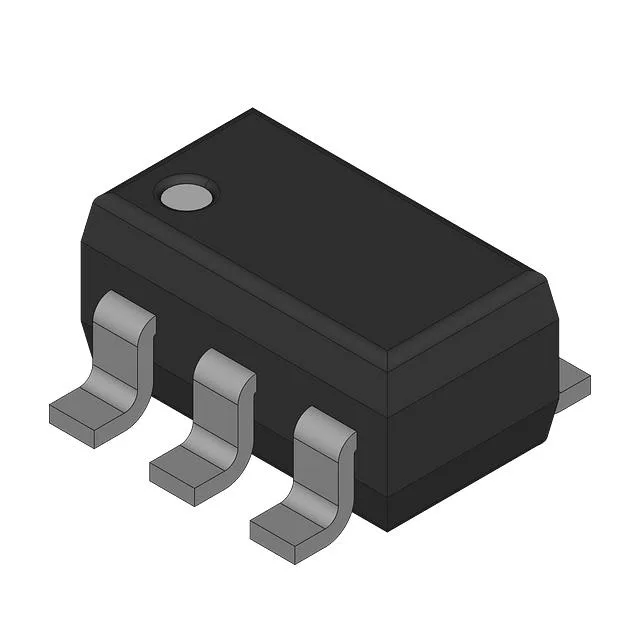
SOT-23-5 package — footprint and assembly
Housed in a SOT-23-5 (SC-74A) package, the MAX4175BJEUK-T uses a compact, industry-standard footprint. Surface-mount assembly is straightforward with standard reflow profiles. The supplier device package is SOT-23-5, and the package/case is SC-74A, SOT-753.