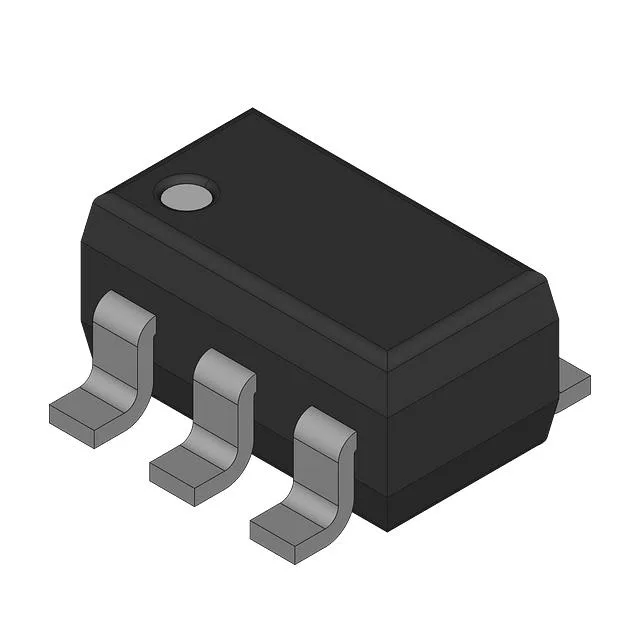
The MAX4175AGEUK: It delivers a gain-bandwidth product of 2 MHz and a -3 dB bandwidth of 970 kHz, drawing just 355 µA of supply current.
Slew rate and bandwidth — the real-world signal limits
If your application needs to swing several volts at frequencies above 100 kHz, this part will round off the edges. For audio, sensor filtering, or slow control loops, it is fine. The 970 kHz -3 dB bandwidth and 2 MHz GBWP confirm it as a general-purpose amplifier, not a high-speed or video part.
Supply range and rail-to-rail output simplify the rail
The rail-to-rail output lets you swing close to the supply rails, which is useful when driving an ADC input or a comparator threshold directly. Input offset is 500 µV typical, input bias current is 50 pA — adequate for many general-purpose signal paths, but not a precision amplifier.