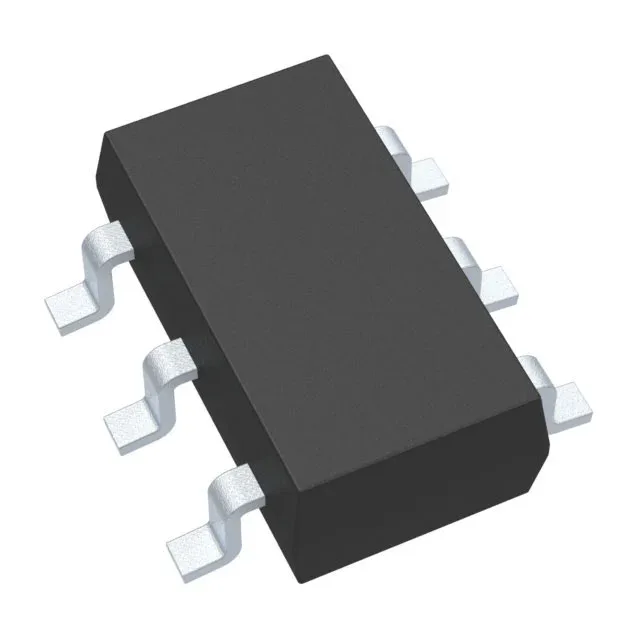
Current sense amplifier for precision shunt monitoring
The Maxim Integrated MAX40010TAUT+T is a single-channel current sense amplifier in a SOT-23-6 package, designed to measure voltage across a shunt resistor with a 12 µV input offset and 80 kHz bandwidth. It operates from a 2.7 V to 5.5 V supply and draws 350 µA quiescent current, suiting it for low-side or high-side current monitoring in DC/DC converters, motor drives, and battery-management systems.
80 kHz bandwidth — what it means for transient response
The 80 kHz -3 dB bandwidth sets the upper frequency for accurate current reproduction. In a switch-mode power supply loop, this is fast enough to capture inductor-current ripple at switching frequencies up to several hundred kilohertz, but it will average out sub-microsecond current spikes. For motor-phase current sensing at PWM rates below 40 kHz, the bandwidth provides clean waveform reconstruction without excessive noise gain.
12 µV offset and 65 µA input bias — precision without calibration
A 12 µV input offset voltage means the error at the shunt is negligible for most designs — a 10 mV drop across a 10 mΩ shunt carrying 1 A yields a 0.12% offset error, eliminating the need for trim or calibration in production. The 65 µA input bias current is the current drawn into the sense inputs; it flows through the shunt and can introduce a small voltage drop, so keep shunt values below a few ohms to keep the bias-induced error under 1%.