What the 10 Ohm on-resistance means for your signal path
The MAX312CSE+ is a quad SPST-NC (normally closed) analog switch from Analog Devices, with a maximum on-resistance of 10 Ohm across the specified supply range. This low Ron minimises voltage drop and signal attenuation in precision analog routing — audio, data acquisition, or instrumentation paths where every millivolt matters. The 300 mOhm channel-to-channel matching keeps gain errors consistent across all four switches, simplifying calibration.
Supply voltage flexibility — single or dual rails
That covers common ±5 V, ±12 V, and ±15 V analog rails, as well as single 5 V or 12 V digital systems. The wide compliance range means you can reuse the same BOM position across multiple board variants without re-spinning the power tree. Switching times are 225 ns max for turn-on and 185 ns max for turn-off, fast enough for audio multiplexing, sample-and-hold front ends, or low-speed data switching up to a few megahertz.
Active production — sourcing through authorized channels
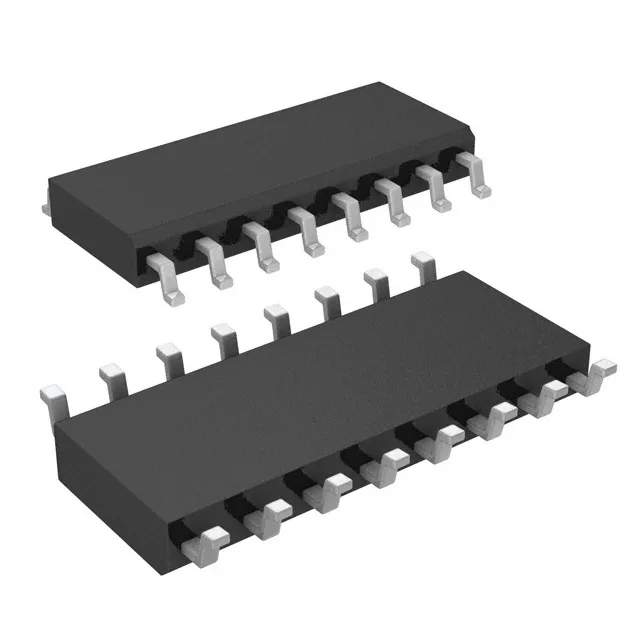
The part is supplied in a tube and uses the standard 16-SOIC (0.154-inch width, 3.90 mm) footprint, which is widely supported across PCB assembly houses. For volume pricing and lead times, submit an RFQ against your BOM quantity.
Crosstalk and charge injection — bench-level isolation
Channel crosstalk is rated at -85 dB at 1 MHz, which keeps the signal on one channel from bleeding into an adjacent channel in multi-plexed applications. Charge injection is 20 pC typical — low enough that the glitch at the switch node won't disturb a 16-bit ADC's conversion if the sampling capacitor is large enough to absorb it. Off-leakage current is 500 pA max, so the hold time on a sample capacitor is dominated by the capacitor's own dielectric absorption, not the switch.