What the 6V to 36V input range means for your rail design
The MAX25431ATGA/VY+ is a single-output, positive-configuration buck-boost controller from Maxim Integrated, built around a buck-boost topology that handles step-up and step-down conversion from a 6V to 36V supply rail. The 6V minimum input means it can start from a deeply discharged automotive battery or a 12V rail during cold-crank conditions, while the 36V maximum covers the nominal 24V truck bus and survives load-dump transients without an external clamp.
2.2MHz switching and the inductor size trade-off
Switching at 2.2MHz, the controller pushes the fundamental ripple frequency well above the AM radio band, which simplifies input filtering in automotive head-unit and body-control applications. The high switching rate also shrinks the inductor value and footprint — a 2.2MHz design typically uses a 2.2µH to 4.7µH inductor, compared to 10µH or more at 400kHz, saving board area in the 24-SWTQFN (4x4) layout. Clock sync is available, so the switching edge can be aligned to an external clock to avoid beat-frequency interference in multi-rail systems.
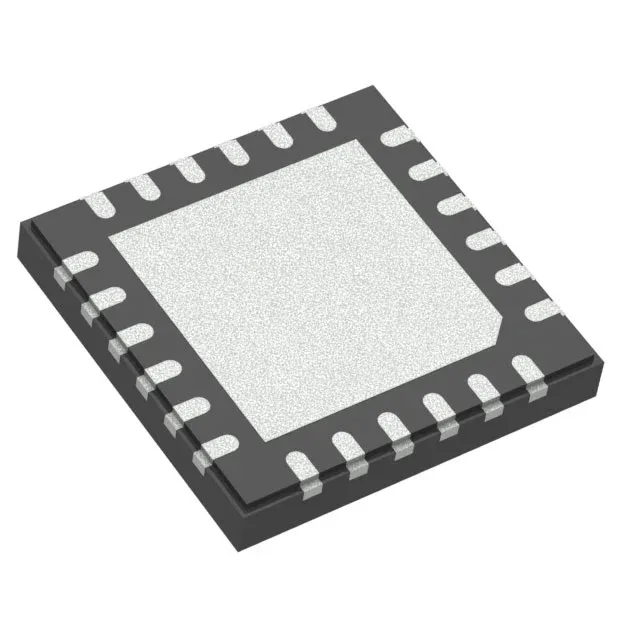
Package and board-fit: 24-SWTQFN with wettable flank
The 24-WFQFN exposed-pad package (4x4 mm, 0.5 mm pitch) with wettable flank termination allows automated optical inspection (AOI) of the solder joints — a requirement for automotive-grade assembly lines that cannot rely on X-ray alone.
Control features and output stage
The controller integrates Enable, Frequency Control, Power Good, and Soft Start — the Power Good flag can sequence downstream converters, and Soft Start limits inrush during the first few switching cycles. It drives an external transistor pair (two output phases) and does not include synchronous rectifiers internally, so the designer selects the external FETs and Schottky catch diodes to match the load current and efficiency target.
Lifecycle and compliance status
RoHS3 compliant — no exemptions for lead in solder, so it ships with the standard matte-tin finish on the wettable flank pads.