Under-hood LDO with 36V load-dump headroom
The MAX25210ATAA8/V+ is a single-output automotive LDO from Analog Devices, part of the AEC-Q100 series, delivering a fixed 3.3V or 5V rail at up to 300 mA. Its 36V maximum input rating means it sits on a 12V battery bus and survives a load-dump transient without an external clamp — the internal pass FET's abs-max covers the surge. The 0.77 V dropout at full load gives you about 0.5 V of headroom on a 6 V cold-crank battery feeding the 5 V output — enough margin to keep the rail in regulation during the deepest dip.
PSRR and quiescent current — noise floor vs standby budget
PSRR is 60 dB at 100 Hz — that is the ripple rejection at the fundamental of a full-bridge rectifier. Upstream switching noise above a few kHz passes through with less attenuation, so if the input comes from a DC-DC converter at 400 kHz, the LDO alone won't clean it; a pre-filter inductor or ferrite bead ahead of the input is needed. Quiescent current is 38 µA typical — the regulator's own draw is low enough for an always-on ECU module that sleeps between ignition cycles. The Enable pin lets a supervisor shut the output entirely, dropping Iq to near zero.
Package and rework — 8-TDFN with exposed pad
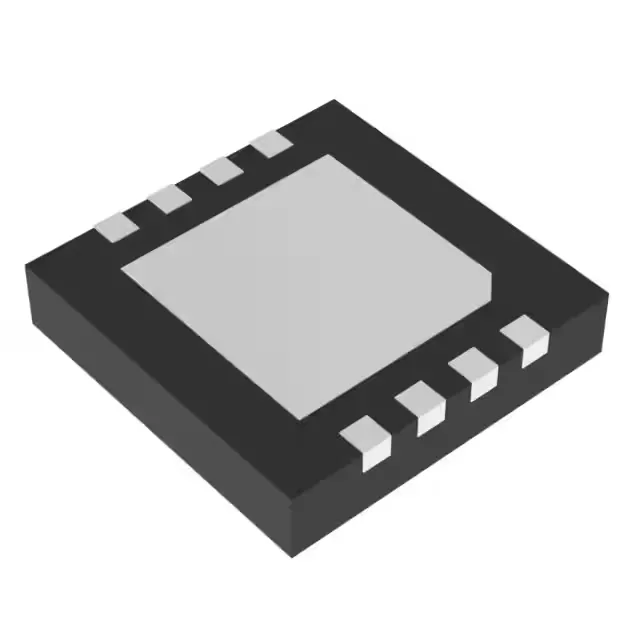
The 8-WDFN with exposed pad (3x3 mm body) is a rework-friendly footprint — the pad is large enough to hand-solder with a hot-air station if you pre-tin the board land and the package backside. Without it, the 125°C junction limit is reached at lower ambient temperatures.
Protection and control — fault-tolerant rail supervision
Built-in over-current, over-temperature, and UVLO protection mean the LDO shuts itself down before it damages the load or the board. The Reset Out pin provides a power-good signal — the downstream microcontroller can hold its reset until the 3.3V or 5V rail is stable. Operating temperature spans -40°C to 125°C junction — AEC-Q100 Grade 1, the under-hood band. An engine-bay ECU that sees 105°C on a summer day still has 20°C of junction margin at full load.