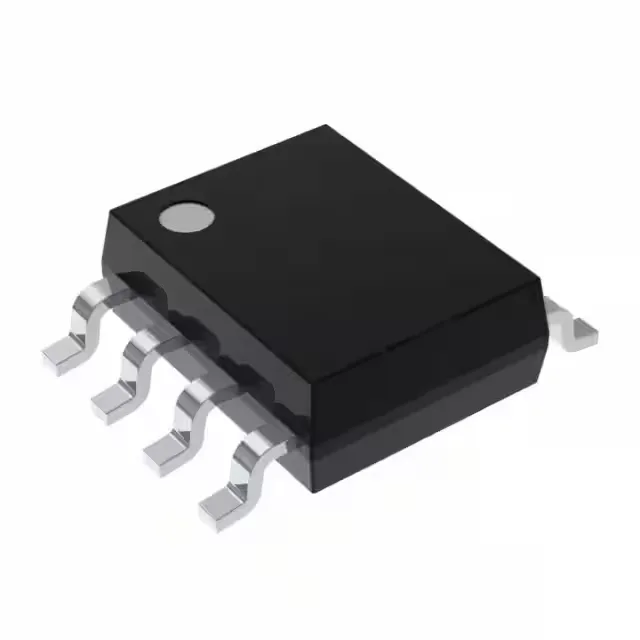
Package and board integration — 8-SOIC footprint
The MAX22701DASA+: The supplier device package is 8-SOIC, so the thermal pad and pin 1 orientation follow the usual SOIC-8 convention.
What 300kV/µs CMTI means for SiC and GaN gate drive
The headline spec on this part is the 300kV/µs common-mode transient immunity — that is the rate of voltage slew between input and output that the isolation barrier can reject without corrupting the output state. For a silicon-carbide (SiC) MOSFET switching at 50-100 V/ns in a half-bridge, the common-mode dv/dt across the isolated gate driver can easily exceed 100 kV/µs. The MAX22701DASA+ is explicitly described as an ultra-high CMTI silicon-carbide gate driver, meaning it is designed to hold the gate signal clean through those transients. The 300kV/µs figure gives roughly 3× margin over a typical 100 kV/µs SiC switching event, which keeps the output from glitching or latching. The capacitive coupling technology is what enables that CMTI — capacitive isolators use on-chip differential capacitors to transfer the signal across the isolation barrier, which inherently rejects common-mode slew better than optocoupler or transformer-based approaches at high dv/dt. The trade-off is that capacitive coupling needs a clean input-side supply; the output supply range is 13V to 36V, which covers standard SiC gate drive rails (typically +15V to +20V on, -5V to -2V off) with headroom for the Miller clamp.
Timing margins for 1 MHz+ switching frequencies
Propagation delay is 36ns max for both rising and falling edges, and pulse width distortion is held to 2ns max. For a 1 MHz switching frequency (1 µs period), 36ns propagation delay is 3.6% of the switching period — well within the dead-time budget for most SiC half-bridge designs. The 2ns pulse width distortion means the on-time error between channels (in a dual-driver setup) stays under 2ns, which matters for preventing shoot-through at high bus voltages. Rise and fall times are 2.5ns typical, so the gate driver can charge the SiC input capacitance (typically 1-5 nC) fast enough to keep switching losses low.