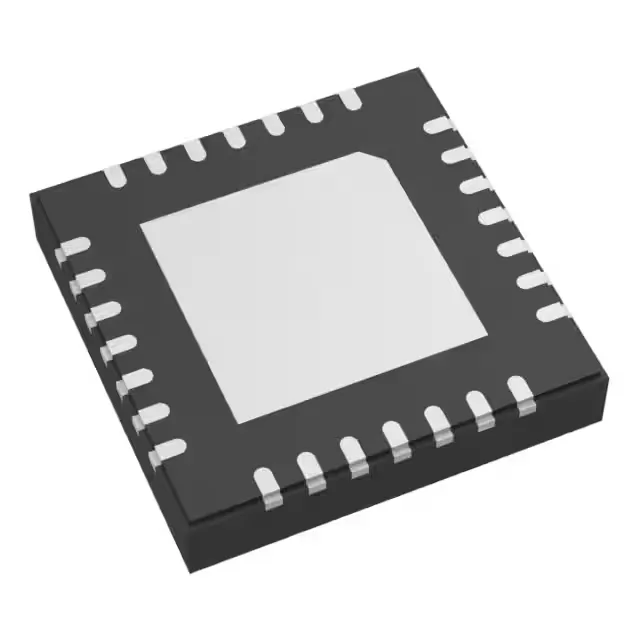
Automotive single-cell Li-Ion charger with digital control
It integrates an I²C and SMBus interface for programmable charge current and voltage, and operates from a supply up to 36V, covering 12V and 24V vehicle systems. Packaged in a 28-WFQFN with wettable flank (28-TQFN 5x5), it supports automated optical inspection (AOI) in production.
Charge current and supply headroom for real-world rails
The 1A maximum charge current is a practical rate for single-cell Li-Ion packs in automotive telematics, dashcams, and portable diagnostic tools. The 36V supply maximum gives headroom for load-dump transients on a 12V bus and allows direct operation from a 24V truck battery without an external pre-regulator. The constant-current charging mode simplifies the power stage — no complex compensation network needed.
I²C/SMBus interface for dynamic charge control
The I²C and SMBus interface lets a system MCU adjust charge current, termination voltage, and fault thresholds in real time. This is useful for thermal management — reducing charge current when the ambient temperature climbs above 85°C — or for supporting different battery chemistries without a hardware change. The bus also reports fault status, which can trigger a diagnostic message in an automotive ECU.
Package and footprint for automotive assembly
The 28-TQFN (5x5 mm) with exposed pad and wettable flank is a standard automotive-grade package. The wettable flank enables AOI of solder joints, which is a requirement for many Tier-1 automotive production lines. The surface-mount, wettable-flank mounting type is specified for lead-free reflow per ROHS3 compliance.
It is ROHS3 compliant.