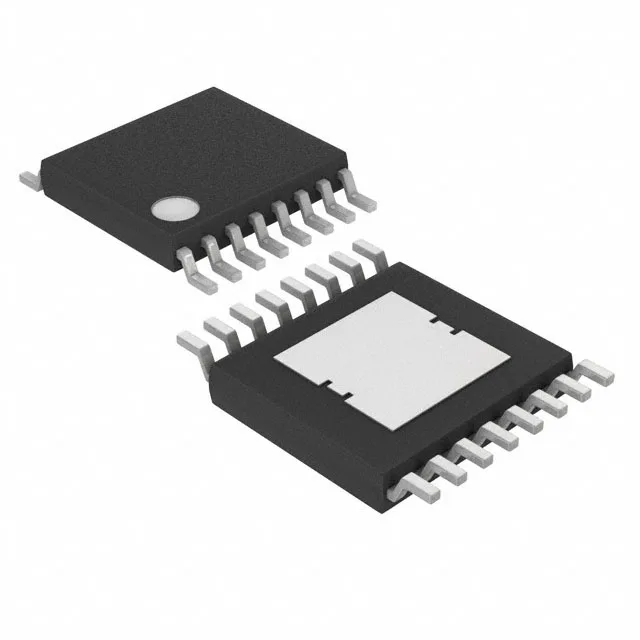
LED driver controller with multi-topology flexibility
The MAX16833BAUE+ is a DC-DC controller IC designed for LED driving, supporting buck, boost, SEPIC, and flyback topologies. That means a single BOM line can serve a high-bay light string (boost) or a low-voltage automotive taillight (buck) without a board spin. It accepts a 5V to 65V supply range, so it starts from a nominal 12V automotive rail and survives load-dump transients without an external clamp. The internal controller handles the regulation loop; an external MOSFET carries the load current.
Dimming and switching frequency trade-offs
Both analog and PWM dimming are supported, giving the designer a choice: PWM for a wide dimming ratio with constant color temperature, or analog for simpler filtering in a non-critical fixture. The switching frequency is programmable from 100kHz to 1MHz — a 200kHz setting keeps inductor size small and switching losses low; 1MHz shrinks the magnetics further but pushes more heat into the gate driver. In a 125°C ambient under-hood environment, the pad's thermal resistance sets the junction temperature — the datasheet's thermal model is the one to trust for the actual board stack-up.