What this linear LED driver brings to a lighting BOM
Each of the three outputs delivers up to 150 mA, and the part operates from a supply rail between 6.5 V and 28 V, making it a direct fit for 12 V and 24 V automotive electrical systems. The internal switches handle the current regulation, so no external MOSFET is needed per channel — a BOM simplification that matters when board space is tight.
With three independent outputs rated at 150 mA each, the MAX16824AUE+ can drive three separate LED strings or one string with three paralleled channels for a higher total current (up to 450 mA, but watch the package thermal limit). The linear regulation means no switching noise on the output, which is preferred in applications like automotive taillight or daytime-running-light modules where conducted emissions must stay low. The 36 V output rating gives headroom for series LED strings in a 24 V nominal system.
PWM dimming — the feature that separates this from a fixed-current sink
The PWM dimming input allows the LED current to be chopped at a frequency chosen by the system designer, enabling brightness control without shifting the LED color temperature. This is the standard approach for automotive interior dimming and display backlighting. Because the driver is linear, the PWM switching edge is clean — no inductor ringing to manage.
Temperature range and package — designed for under-hood and outdoor
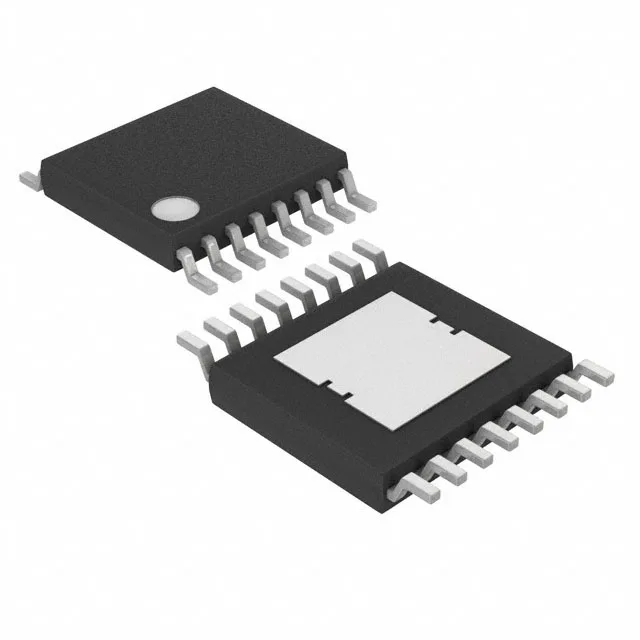
Without that thermal via stitch, the junction temperature will climb quickly above 85°C ambient at full 150 mA per channel.
For BOM lines that need a qualified second source, the linear LED driver market has several pin-compatible alternatives — but none are listed as an official cross in the Maxim documentation.