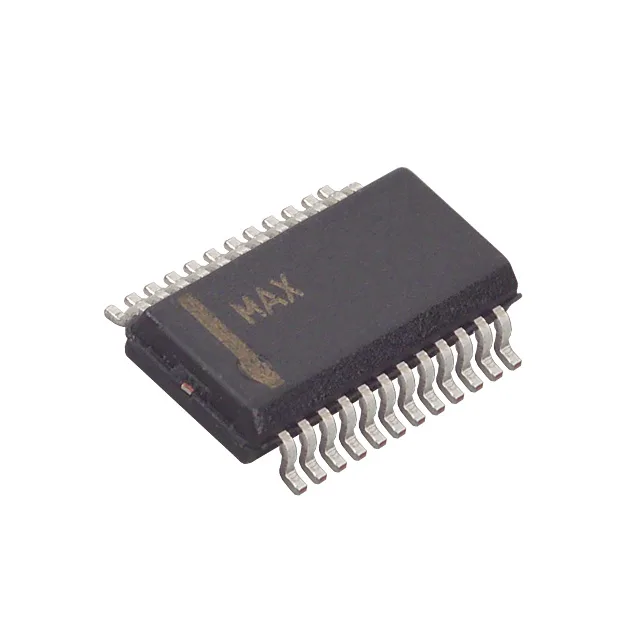
16-bit SAR ADC with 200k SPS — what the sampling rate means for your scan cycle
The MAX1168BEEG+ is a 16-bit successive-approximation-register (SAR) ADC that samples eight single-ended inputs at 200k samples per second. That 200k SPS is the aggregate throughput across all channels — if you scan all eight in round-robin, each channel sees about 25k SPS, which is fast enough to capture 50 Hz or 60 Hz mains ripple with plenty of margin for a digital filter. The internal multiplexer (MUX-S/H-ADC configuration) feeds the sample-and-hold, so the input capacitance and settling time matter at the board level. With an SPI data interface, the conversion result shifts out on the serial bus — the host reads the data directly without a parallel bus, which saves pins on the controller side.
Supply rails and reference — what fits where
Analog supply is fixed at 5V, while the digital supply runs from 2.7V to 5.25V. That means you can interface the SPI bus directly to a 3.3V microcontroller without a level shifter — the digital I/O swings with the digital supply rail. If your system already has a clean 5V analog rail and a 3.3V logic rail, this ADC drops right in. The reference can be either external or internal. Using the internal reference saves a component and a PCB trace, but if you need a ratiometric measurement or a specific voltage span, an external reference overrides it. The 24-QSOP package (3.90 mm wide SSOP footprint) keeps the board area small — useful when the ADC sits close to the sensor connector.