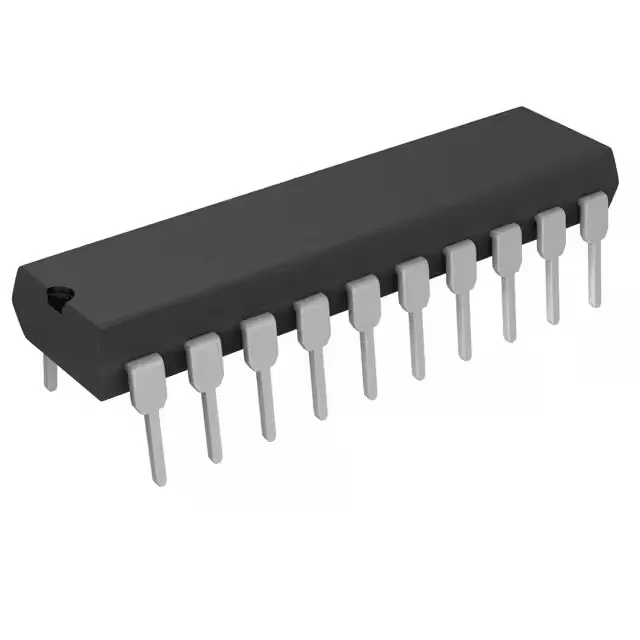
12-bit R-2R DAC with 1 µs settling — the breadboard-friendly workhorse
The LTC7545AKN#PBF is a 12-bit multiplying digital-to-analog converter built around a classic R-2R ladder architecture, delivering a current-unbuffered output that settles in 1 µs typical. Its parallel data interface and external reference let you feed a 12-bit word straight from a microcontroller or FPGA bus, with the output current scaling linearly with the reference voltage. The 20-pin PDIP package (0.300" wide, 7.62 mm) is a through-hole part that fits standard breadboards and prototyping boards — no fine-pitch soldering required.
Linearity and monotonicity — what ±0.5 LSB INL means on the bench
Integral non-linearity is specified at ±0.5 LSB maximum, and differential non-linearity at ±1 LSB maximum — this guarantees monotonicity across all 4096 codes, so the output never steps backward as the digital input increments. For a 12-bit converter with a 5 V reference, ±0.5 LSB INL corresponds to about ±1.2 mV of absolute error at the output — tight enough for most industrial set-point and trimming applications without external calibration. The 1 µs settling time to ±0.5 LSB means you can update the output at up to roughly 1 MHz word rate, though the actual throughput depends on the bus write cycle and the op-amp you use to convert the current output to a voltage.
Supply rails and temperature range — planning the power budget
The LTC7545AKN#PBF runs on dual analog/digital supplies: a 5 V logic rail and an analog supply that accepts either a single 5 V or a split 14.25 V to 15.75 V — the higher analog rail gives you more headroom for the output compliance range.
The part is ROHS3 compliant, so it meets the latest EU hazardous-substance restrictions without needing a waiver.