3.5V to 60V input, 50kHz to 850kHz switching — what that means for your rail
The LTC3863IMSE#PBF is a current-mode step-down (buck) controller that takes a 3.5V to 60V supply and drives an external N-channel MOSFET. That 60V max input covers a 48V telecom bus with margin for transients, a 12V automotive rail through cold-crank dips and load-dump spikes, or a 24V industrial supply without an external pre-regulator. Switching frequency is programmable from 50kHz to 850kHz — the low end lets you use a physically larger inductor for lower core loss at light loads, while the high end shrinks the magnetics for a dense board. No clock sync input, so the part free-runs; plan for beat-frequency filtering if the load draws switching noise into a sensitive analog section.
Positive or negative output — inverting buck-boost without a second controller
The output configuration is selectable for positive or negative regulation. Tie the feedback to a positive rail for a standard buck, or reference it to ground to generate a negative output from a positive input — the same external MOSFET and inductor handle both topologies. That saves a second controller IC when you need a -5V or -12V rail off a 12V or 24V bus. No synchronous rectifier means the low-side is a Schottky diode, not a second FET. Simpler gate drive, lower cost, and no risk of shoot-through, but the diode conduction loss sets the efficiency ceiling at high current. This controller is aimed at moderate-current rails (a few amps) where the diode drop is acceptable.
Package and thermal — 12-MSOP-EP with exposed pad
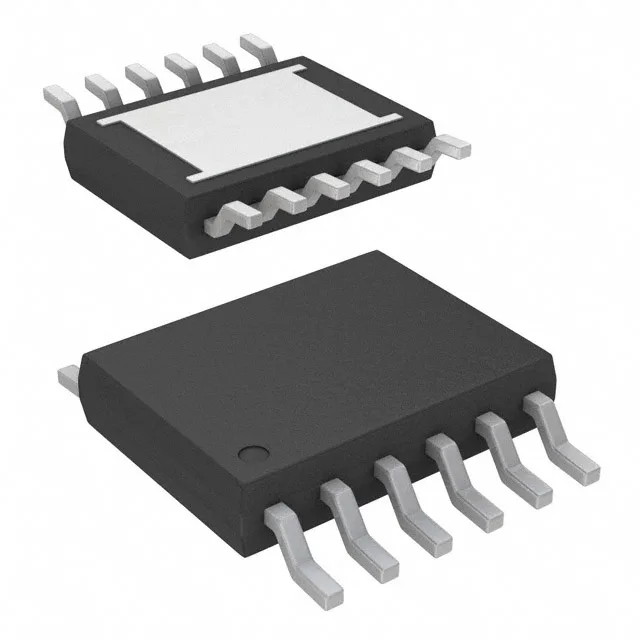
The 12-MSOP-EP (3.00mm × 3.00mm body, 0.118" width) has an exposed pad on the bottom. The part is rated for junction temperatures up to 125°C — the thermal resistance from junction to ambient depends on the board copper area under the pad, not just the package itself. Tube packaging — the MSOP-EP is not a high-volume reel part in this variant. Expect the ICs to ship in a standard anti-static tube; the pick-and-place feeder needs a tube-compatible shuttle or a manual tube-to-reel transfer.
Active lifecycle and compliance — no end-of-life watch needed
In a 85°C ambient enclosure with a 20°C rise from self-heating, the junction sits at 105°C, leaving 20°C margin before the absolute max. Derate the output current if the board copper is small or the airflow is zero.