Three-phase buck controller for high-current POL rails
The LTC3731HUH#PBF is a three-phase synchronous buck controller from the PolyPhase series, designed to deliver high current to low-voltage processor cores, ASICs, and memory rails by interleaving three converter phases. Each phase operates 120° out of phase, reducing input and output ripple current without increasing switching frequency — the effective ripple frequency seen by the output capacitor is three times the per-phase switching rate, so smaller, lower-ESR caps can be used for the same output ripple. Switching frequency is programmable from 225 kHz to 680 kHz via a single resistor, letting you trade efficiency (lower frequency) against inductor size and output ripple (higher frequency).
Package, footprint, and thermal interface
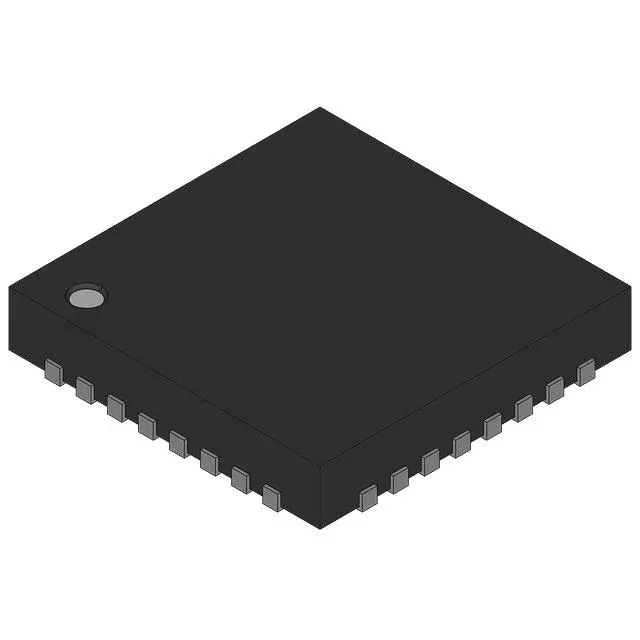
The exposed pad is the primary thermal path; soldering it to a continuous copper pour on the top layer with at least nine vias to the inner ground layers keeps the junction temperature within the -40°C to 140°C operating range under full load. The QFN package is hand-solderable with a hot-air rework station and a fine-tip iron for the perimeter leads — the 0.5 mm pitch is manageable with a decent stencil and a microscope.
Control architecture and output stage
Output configuration is positive with a transistor-driver output type — the controller drives external N-channel MOSFETs on both the high side and low side (synchronous rectifier), so the efficiency gain from synchronous rectification is built in without an external Schottky catch diode. Maximum duty cycle of 98.5% means the high-side FET can stay on nearly the whole cycle — useful for low dropout scenarios where the input is only a few hundred millivolts above the output. Control features include enable, phase control for sequencing or spread-spectrum, power-good output for reset generation, and a soft-start pin that sets the ramp time with an external capacitor.