Active production — sourcing and compliance
The LTC3425EUH#PBF: It is ROHS3 compliant, covering the full exemption-free RoHS directive — no special handling or documentation waivers needed for EU or California market shipments.
Boost converter parametrics and the 5A switch
This is a step-up (boost) regulator with a single 5A switch integrated on-chip. The 5A figure is the switch current limit, not the continuous output current — the actual output current depends on the input-to-output voltage ratio and the inductor ripple. At a 3.3V input producing 5V out, expect roughly 2.5A continuous to the load before the switch hits its cycle-by-cycle limit. The input range spans 0.5V minimum to 4.5V maximum, which means it can start from a single-cell alkaline (0.9V fresh) or a Li-ion cell near its end-of-discharge voltage (2.7V). The 0.5V minimum is the undervoltage lockout threshold — the part will not start below that, but once running it can regulate down to that input. Output voltage is adjustable from a 2.4V minimum to a 5.25V maximum, set by an external resistor divider feeding the FB pin. The 2.4V floor is the internal reference voltage times the minimum divider ratio — do not try to set the output below that; the error amplifier saturates and regulation is lost. Switching frequency is programmable from 100 kHz to 2 MHz via a single resistor on the RT pin. Lower frequencies (100-400 kHz) give better efficiency at light loads but require a larger inductor; 2 MHz pushes the switching harmonics above the AM broadcast band and shrinks the inductor to a 2.2 µH or 3.3 µH chip type, at the cost of higher switching losses in the internal FET. Synchronous rectification is built in — the low-side catch diode is replaced by a second N-channel FET that turns on during the off-time. This recovers the diode forward drop (typically 0.4-0.5V for a Schottky at 2A) and improves efficiency by 3-5% at output voltages below 3.3V, where the diode drop is a larger fraction of the output.
Package, thermal, and board integration
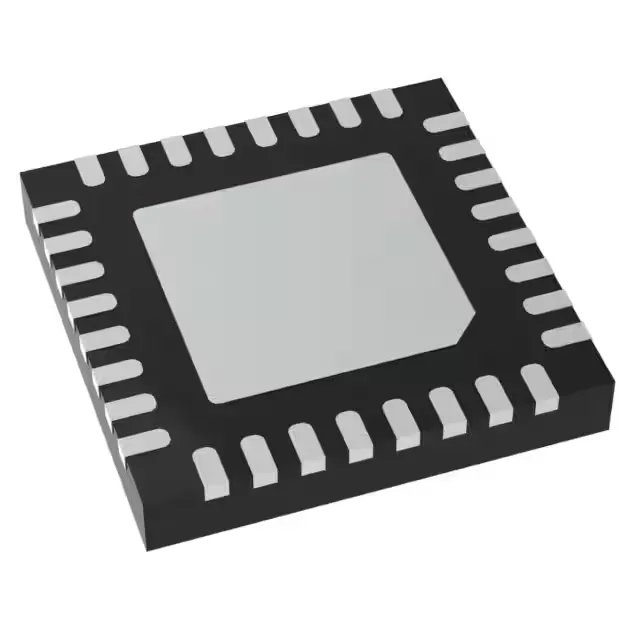
The LTC3425EUH#PBF is supplied in a 32-lead WFQFN with an exposed pad, measuring 5 mm × 5 mm. It is shipped in a tube, not tape-and-reel. For automated pick-and-place, the tube must be loaded into a tube feeder or the parts transferred to tape — factor this into the assembly line setup if the rest of the BOM runs on reel feeders. If the end equipment sees sustained ambient above 85°C, the junction temperature derating from the datasheet (page 7) must be applied; the part will not survive a 105°C ambient without significant current derating.
Cross-reference reality vs ADP1607ACPZN-R7
The ADP1607ACPZN-R7 is also a boost converter with synchronous rectification, but it is rated for only 1A output current versus the LTC3425's 5A switch. The package is different (SC-70-5 vs 32-QFN), and the input voltage range starts at 0.8V rather than 0.5V. These are not pin-compatible or drop-in replacements — the LTC3425 serves a higher-power, wider-input-range application where the ADP1607 would hit its current limit or require a different PCB footprint.