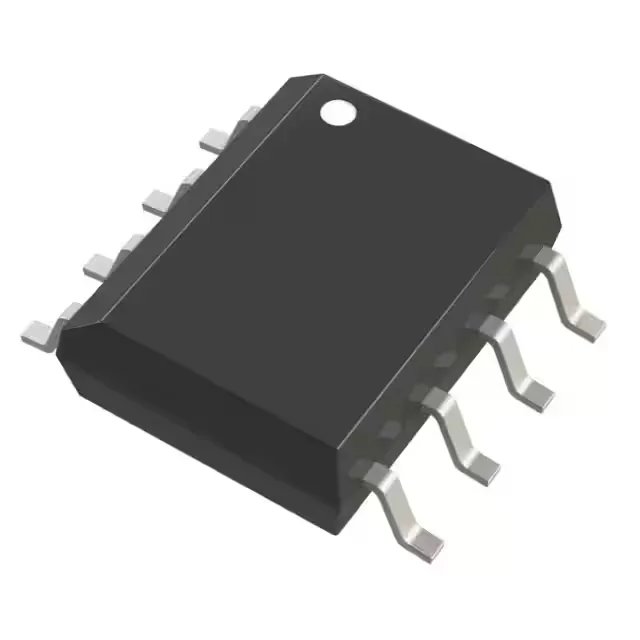
Dual-channel hot swap with latched fault response
The LTC1647-1CS8#PBF is a dual-channel hot swap controller from Analog Devices that manages two independent supply rails from a single 8-SOIC package. It operates over a 2.7 V to 16.5 V supply range and draws 1 mA of supply current. Because it lacks an internal switch, the designer selects external N-channel MOSFETs sized to the load current — this keeps the power dissipation off the controller and lets the same PCB layout scale across a range of board-level currents by swapping the FETs. The programmable features — circuit breaker threshold, fault timeout, and slew rate — are set with external resistors and capacitors, giving the board designer control over the inrush current profile and the overcurrent trip point without a digital interface.
Latched fault vs auto-retry — the peer decision
The key differentiator between the LTC1647-1CS8#PBF and the LTC1647-3CGN#PBF is the fault response: the -1 version latches off after a fault and requires a power-cycle or enable toggle to restart, while the -3 version auto-retries. For a line card that must stay dead after a hard fault until an operator clears it, the latched behaviour is the right choice; for a remote or unattended panel where automatic recovery is preferred, the -3 variant fits. Both parts share the same 2-channel architecture, 2.7 V to 16.5 V supply range, programmable circuit breaker and slew rate, and the 8-SOIC footprint — so a board designed for one can accept the other with only a resistor change to the fault-timing network.
Active lifecycle and compliance documentation
The commercial temperature grade (0°C to 70°C) covers indoor equipment, bench instrumentation, and telecom central-office environments.