A DC/DC controller that doesn't need an internal switch
The LT3755EMSE-2#PBF is a DC/DC controller from Analog Devices built for driving high-brightness LEDs. It's a controller, not a converter — there's no internal switch, so you pick the external MOSFET and inductor to match the load current and topology. That means it handles boost, buck, flyback, and SEPIC configurations, making it a single BOM line for a range of LED strings from a few hundred milliamps to several amps, depending on the external components.
100 kHz to 1 MHz — where the frequency lands matters
A lower frequency cuts switching losses and lets you use a bigger inductor with lower core loss, which helps in thermally constrained enclosures. Crank it to 1 MHz and you shrink the magnetics and output capacitor, but you'll need to watch gate-drive losses and layout parasitics. The frequency pin accepts a resistor to ground — no external clock needed.
4.5 V to 40 V supply — automotive and industrial rails
The input range runs from 4.5 V up to 40 V. That 4.5 V minimum means it starts from a standard 5 V rail or a single Li-ion cell, and the 40 V ceiling covers 24 V industrial buses and 12 V automotive systems with load-dump transients (as long as you add external clamping).
Analog and PWM dimming — two ways to control brightness
Dimming is supported in both analog and PWM modes. Analog dimming adjusts the LED current linearly via a control voltage, which is simple and noise-free. PWM dimming switches the LED string at a frequency above visible flicker, giving a wider dimming range and better color consistency — useful in architectural or backlighting designs where the LED current must stay constant during the on-time.
Package and thermal — the exposed pad is your friend
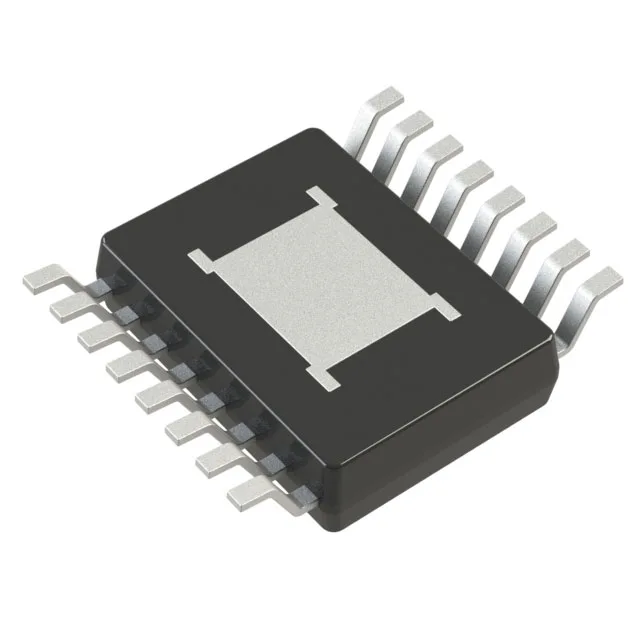
It comes in a 16-lead MSOP with an exposed pad. The pad is also the GND connection, so the PCB layout needs a solid thermal and electrical connection. The mounting is surface-mount, so reflow profiles follow the standard MSOP-EP footprint.