Negative rail, fixed -2.5V — the fit check
The LT3015IMSE-2.5#PBF is a negative-output linear regulator from Analog Devices, part of the LT3015 family. Its fixed -2.5V output and 1.5A current capability make it a natural choice for generating a local negative supply rail on mixed-signal boards — think op-amp negative rails, ADC reference supplies, or bias voltages for RF front-ends that need a clean -2.5V. The key fit parameter is the polarity: this is a negative regulator, not a positive one. If your BOM calls for a -2.5V rail at 1.5A, this part drops in. If you need a positive output, the LT1963 family is the positive counterpart.
PSRR and dropout — what the numbers mean for your rail
PSRR is 62 dB at 120 Hz — that's about 1.26 mV of ripple on the output for every 1 V of ripple on the input at that frequency. For an audio or instrumentation circuit powered from a switching converter, this level of rejection cleans up the 120 Hz (or 100 Hz) mains-frequency ripple well enough that it won't couple into the signal chain. Above 120 Hz, PSRR rolls off; the datasheet curve (not reproduced here) shows how much margin you have at the switching frequency of your upstream converter. Dropout voltage is 0.5 V maximum at 1.5 A load.
Package and hand-solderability
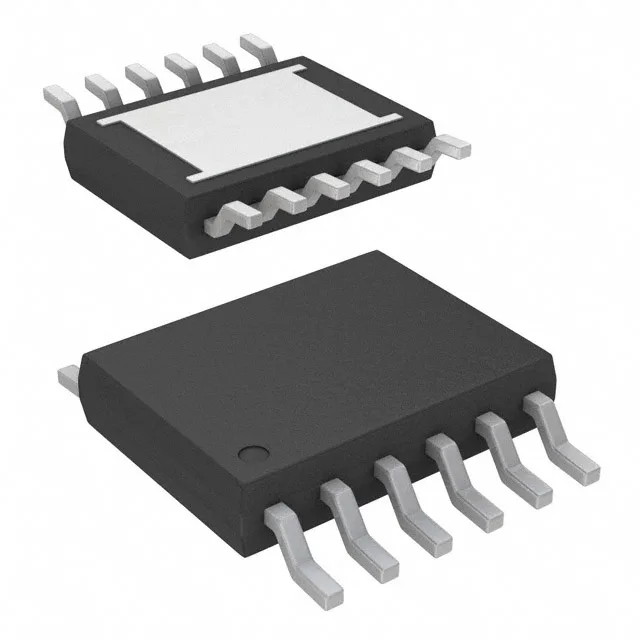
The part comes in a 12-lead MSOP with an exposed pad (12-MSOP-EP). The package ships in a Tube, not tape-and-reel, so it's suited for low-volume assembly or bench prototyping.
The protection features — over-current, over-temperature, and reverse polarity — make it robust against common fault conditions on a negative rail.