Negative rail LDO with 62 dB ripple rejection at line frequency
The LT3015EDD-2.5#PBF is a fixed -2.5 V output LDO from Analog Devices, delivering up to 1.5 A from a negative input rail as low as -30 V. Its 62 dB PSRR at 120 Hz means it attenuates the 100/120 Hz ripple from a full-wave rectified supply by a factor of roughly 1250 — critical for powering sensitive analog front-ends that share a rail with a motor drive or switching converter. The 0.5 V maximum dropout at 1.5 A sets the headroom requirement: the input must be at least 0.5 V more negative than -2.5 V (e.g., -3.0 V or lower) to keep the output in regulation under full load.
Thermal and layout — the exposed pad is the heat pipe
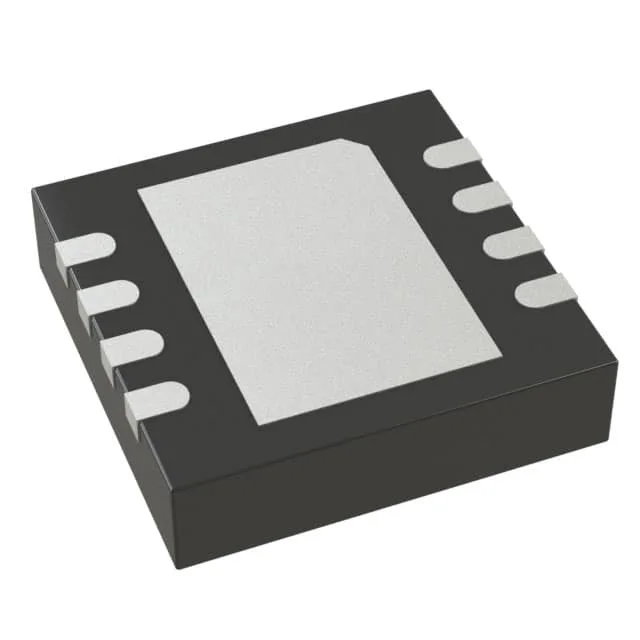
Housed in an 8-WFDFN with exposed pad (3x3 mm DFN), the LT3015EDD-2.5#PBF relies on the pad soldered to a PCB copper plane for thermal dissipation. At 1.5 A with 0.5 V dropout, the die dissipates 0.75 W — the junction-to-ambient thermal resistance of this package on a standard 2-layer board is around 40-50 °C/W, so the junction rises 30-38 °C above ambient. In a 85 °C enclosure, that puts the junction at 115-123 °C, still within the -40°C to 125°C operating range, but with little margin. A 4-layer board with thermal vias under the pad drops RthJA significantly. The enable pin (active high, 1.2 V threshold typical) lets a supervisor or GPIO sequence the negative rail on after the positive rail is stable — common in dual-supply op-amp circuits where the positive rail must come up first to avoid latch-up.
Protection suite — reverse polarity saves an external diode
Built-in reverse polarity protection means the LT3015EDD-2.5#PBF survives a reversed input connection without an external Schottky in series — the internal pass element blocks reverse current. Over-current and over-temperature shutdown round out the protection set, making it suitable for industrial control boards where field wiring faults are common.