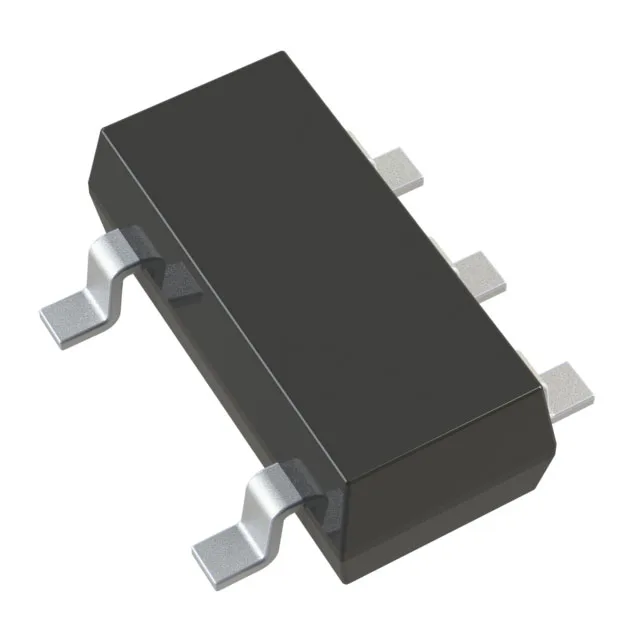
TSOT-23-5 multi-topology switcher
The LT1613CS5#TRPBF is a current-mode DC-DC converter from Analog Devices that handles boost, flyback, and SEPIC topologies from a single TSOT-23-5 package. It integrates a 550 mA switch and runs at a 1.4 MHz switching frequency, keeping external inductor and capacitor values small enough for compact, single-layer boards. Input range spans 0.9 V to 10 V, with an adjustable output that can go as high as 34 V. That 0.9 V minimum means it can start from a nearly depleted single-cell alkaline or a Li-ion battery near its end-of-discharge voltage.
What the 550 mA switch rating means on the bench
The 550 mA figure is the peak switch current limit, not the continuous output current. In a boost converter with a 3.3 V input and 5 V output at 200 mA load, the average inductor current sits around 330 mA — the switch sees that plus ripple. The 1.4 MHz switching frequency helps keep ripple low, so you can stay well inside the limit without oversizing the inductor. No synchronous rectifier means the catch diode is external. That diode's forward voltage and switching speed directly affect efficiency — a Schottky with a fast recovery is the usual pairing. The 1.4 MHz edge rate demands a diode with low junction capacitance to avoid ringing. That covers most indoor equipment, bench supplies, and battery-powered portable gear, but not automotive or outdoor enclosures without active cooling.
Footprint and sourcing posture
The TSOT-23-5 footprint is a common 5-pin SOT-23 derivative with a thinner body — 1.0 mm max seated height. The pad layout matches standard SOT-23-5 land patterns; no special thermal vias are required for most loads below 300 mA output.