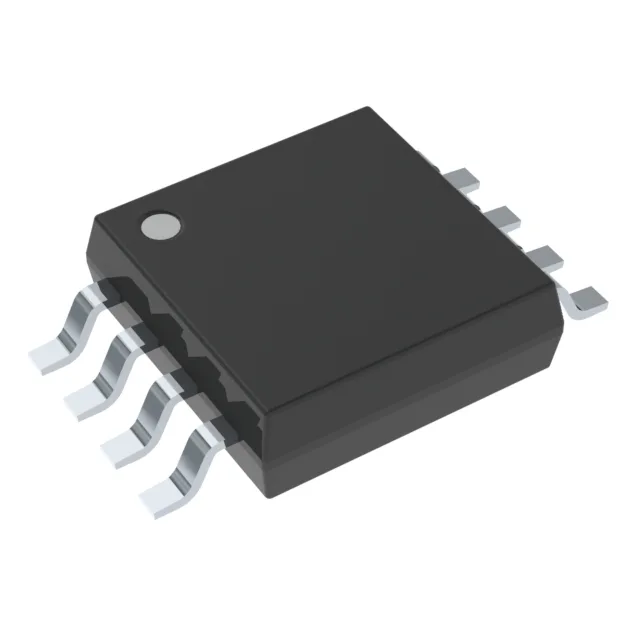
Analog Devices DS1804U-100+T&R — DC-DC Power Modules

DS1804U-100+T&R Digital Potentiometer, 100kΩ, 100 Taps

MPNDS1804U-100+T&R
End of Life

Maxim Integrated DS1804U-100+T&R, digital potentiometer IC, 100kΩ resistance, 100 taps, linear taper, non-volatile memory, Up/Down interface, 2.7V to 5.5V supply, -40°C to 85°C, 8-uMAX/uSOP package.

$4.66Ref. price · indicative, final on quote
Packaging8-TSSOP, 8-MSOP (0.118", 3.00mm Width)
RoHSROHS3 Compliant
Sourced new & surplus through independent channelsAuthenticity-screened · ESD-safe packingListing updated Aug 2026

Specifications

DS1804U-100+T&R specifications
ParameterValue
Memory typeNon-Volatile
MountingSurface Mount
Voltage2.7V ~ 5.5V
InterfaceUp/Down (U/D, INC, CS)
Operating temperature-40°C ~ 85°C
TaperLinear
PackageTape & Reel (TR); Cut Tape (CT)
Tolerance±20%
ConfigurationPotentiometer
Number of taps100
Case8-TSSOP, 8-MSOP (0.118\", 3.00mm Width)
Resistance100k
Number of circuits1
Temperature coefficient750ppm/°C
Resistance - wiper (Ohms)400

Product details

100 taps, 100 kΩ, linear — the trim pot for production calibration

The Maxim Integrated DS1804U-100+T&R is a single-channel, non-volatile digital potentiometer with 100 tap positions and a linear taper over a 100 kΩ end-to-end resistance. It stores the wiper setting in non-volatile memory, so the calibration holds through a power cycle without a microcontroller intervention or external EEPROM. The three-wire Up/Down interface (U/D, INC, CS) is straightforward for a firmware engineer to drive from any GPIO bank — no SPI or I²C bus required, which saves pins on a small MCU. The 2.7 V to 5.5 V supply range covers 3.3 V and 5 V logic rails commonly found in industrial sensor transmitters, programmable power supplies, and audio gain stages.

Wiper resistance and temperature drift — the hidden limits

The wiper resistance is 400 Ω typical, which adds a fixed series offset at the wiper terminal. In a voltage-divider configuration that offset is negligible, but in rheostat mode (wiper to one end) the minimum resistance is 400 Ω, not zero — a detail that matters when setting a low-impedance bias point. The temperature coefficient is 750 ppm/°C typical, so a 100 kΩ setting drifts about 75 Ω per degree. For a room-temperature trim that is fine; for a -40°C to 85°C span the drift can shift the set point by several percent, so budget the tolerance (±20%) plus the tempco in the system error analysis.

Active production, RoHS3, and the 8-uMAX footprint

The 8-uMAX/uSOP package (3.00 mm width, 0.118" pitch) is a common footprint shared with the DS1804-050 and other 8-pin digital pots from Maxim, so a board layout can accommodate multiple resistance values on the same pad pattern. Cut Tape (CT) is also available for prototype quantities.

The DS1804U-050 variant offers 50 kΩ end-to-end resistance with the same tap count and interface, useful when a lower impedance range is needed without changing the PCB layout.

Frequently asked questions

What is the difference between DS1804U-100 and DS1804U-050?

Both are 100-tap, linear-taper digital potentiometers in the same 8-uMAX package with the same Up/Down interface. The DS1804U-100 is 100 kΩ end-to-end; the DS1804U-050 is 50 kΩ. The lower resistance variant suits lower-impedance divider networks or higher current bias trims, while the 100 kΩ version is the standard choice for voltage-divider and sensor offset adjustments.

Can DS1804U-100+T&R be used as a rheostat?

Yes, by connecting the wiper to one end terminal (e.g., H to W) and using the other end (L) as the variable resistance. Note the 400 Ω typical wiper resistance sets the minimum value, so the effective range is 400 Ω to 100 kΩ. The linear taper and 100-tap resolution give about 1 kΩ per step in rheostat mode.

Is DS1804U-100+T&R RoHS compliant?

Yes, it is ROHS3 compliant per the manufacturer's status.

Can I replace DS1804U-100+T&R with DS1804U-100+?

Yes. The DS1804U-100+ is the same die and electrical specification — 100 kΩ, 100 taps, linear taper, non-volatile — in the same 8-uMAX package. The only difference is the packaging medium: the +T&R suffix is Tape & Reel for automated assembly; the + suffix is tube. Both are electrically identical and footprint-compatible.