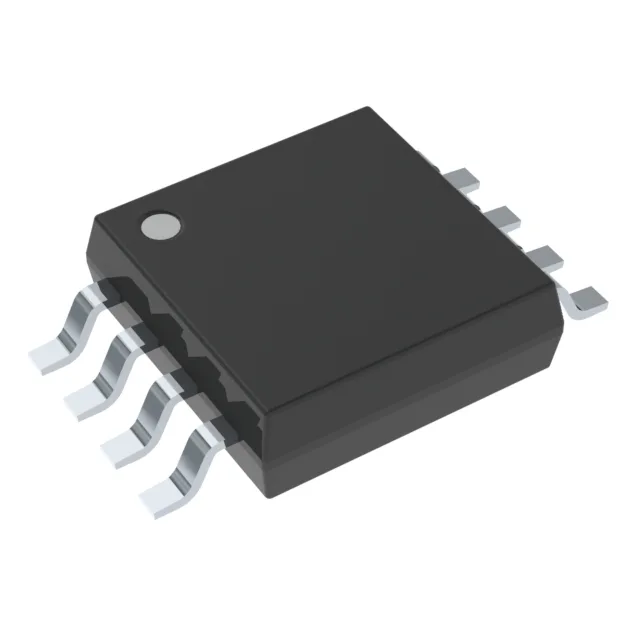
The Maxim Integrated DS1094LU-42M+ is a simple clock generator from the EconOscillator™ series. It takes a clock input and divides it down to a fixed output — no PLL inside, so no frequency synthesis or jitter cleanup. The 2:4 input-to-output ratio means you get four clock outputs from two input references. Max output frequency is 2 MHz, supply runs on a 3V to 3.6V rail (nominally 3.3V). Packaged in an 8-uMAX/uSOP, it's a small footprint for a board that just needs a divided clock without the complexity of a full PLL.
The 3V to 3.6V range locks this part to a 3.3V rail — no 5V tolerance, no wide-range LDO bypass. If your board already runs 3.3V logic, it drops right in. If you're on 5V or 1.8V, you need a regulator. The narrow window means supply ripple matters: keep the decoupling cap close to the supply pin, especially if the board shares a rail with motors or relays.
No PLL — what that changes for your design
With no PLL, this part is a divider-only clock generator. It won't clean up a noisy input clock or multiply a frequency. The output is a direct division of the input — good for generating a lower-speed clock from a master oscillator, bad if you need to lock to a variable reference or synthesize a non-harmonic frequency. If your application needs a clean, multiplied clock, you need a PLL-based part. For a fixed divide-down job, this is simpler and cheaper.
Temperature range and package — field-service reality
Not rated for under-hood automotive or extended high-temp environments. The 8-uMAX/uSOP package is small — 3mm wide — and surface-mount. No socket option, so a field swap means a hot-air station or reflow. Marking is legible under magnification, but orientation is standard: pin 1 index at the top-left when the package is rotated correctly. If you're doing a field repair, pre-program a spare and have the rework kit ready.
ROHS3 compliant. No direct second source listed, but the EconOscillator family includes other divider ratios — check the series if you need a different output frequency.