The Maxim DS1087LU-266+ is a clock generator from the EconOscillator™ family, designed to produce a clean clock output from a reference clock input. It accepts a single-ended clock on one of two input pins (2:1 input-to-output ratio) and delivers a single-ended clock output at up to 66.6 MHz. There is no PLL on chip, so the output frequency is derived directly from the input via an internal divider (divider present, no multiplier). This makes it a low-jitter, deterministic clock source suitable for timing chains where a simple frequency division is needed — think FPGA reference clocks, MCU clock trees, or data-converter sample clocks in industrial control, telecom, or test equipment. The supply range of 2.7V to 3.6V lets it run from a standard 3.3V rail with margin for droop.
The 66.6 MHz maximum output frequency is the headline spec. Because there is no PLL, the output jitter is essentially the input jitter plus the divider's additive phase noise — typically lower than a PLL-based clock generator.
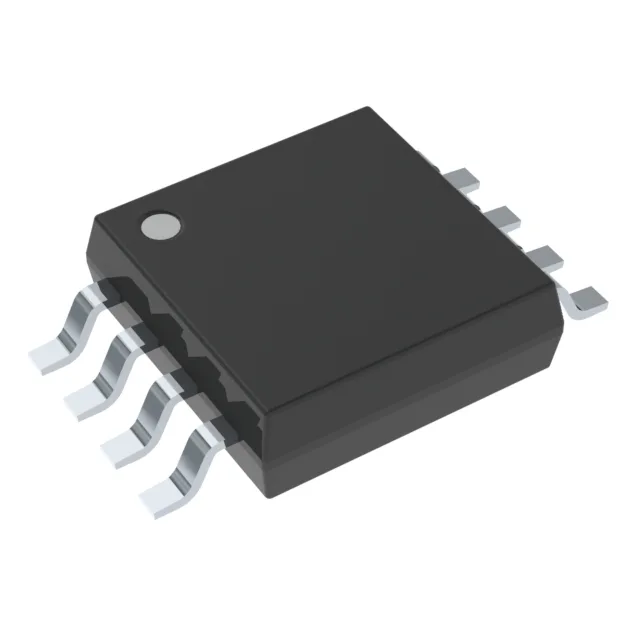
The DS1087LU-266+ comes in an 8-lead TSSOP or MSOP package, 3.00 mm body width — the supplier device package is listed as 8-uMAX/uSOP, which is Maxim's proprietary name for the same 3×3 mm MSOP footprint. This is a small, low-profile package that reworks cleanly with hot air at 300°C to 350°C (typical MSOP profile). No exposed pad, so the thermal path is through the leads only; keep the ambient below 85°C if you are drawing the full supply current. The part is ROHS3 compliant, so no lead-free compatibility issues.
If you need a dual-source option, Maxim's EconOscillator family includes other fixed-frequency variants in the same 8-uMAX package that are pin-compatible, but the exact output frequency will differ; there is no listed second-source alternate from another manufacturer.