30 ns propagation delay — where it sets the timing budget
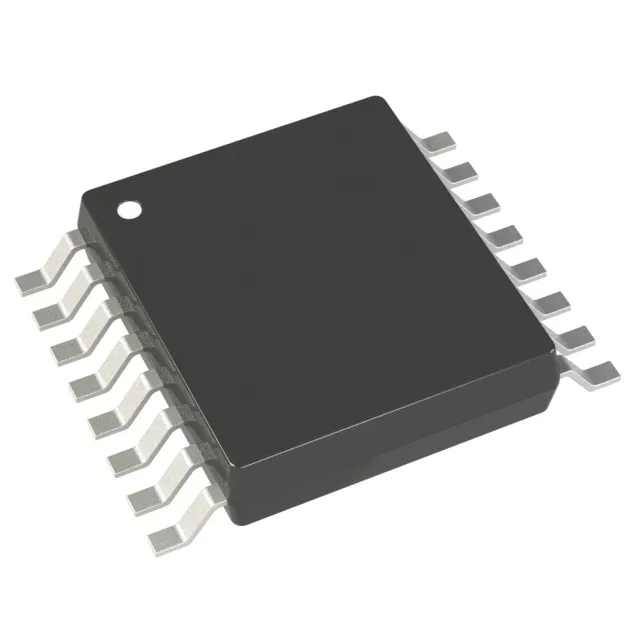
The CMP401GRUZ-REEL is a quad general-purpose comparator from Analog Devices, packing four independent comparators into a 16-TSSOP package. Its 30 ns max propagation delay defines the fastest signal edge the comparator can cleanly resolve — above that frequency, the output transition blurs into the input change, and the comparator loses its decision margin. For a 10 MHz clock edge, 30 ns leaves roughly three clock periods for the comparator to settle before the next edge arrives; below 5 MHz the margin is comfortable.
2 mV hysteresis and 3 mV offset — the switching threshold reality
Built-in 2 mV hysteresis suppresses output chatter when the input signal hovers near the reference threshold — without it, noise on a slow-moving sensor signal would cause multiple transitions per crossing. The 3 mV max input offset at 5 V supply means the actual switching point can shift by up to ±3 mV from the ideal threshold; for a 10 mV peak-to-peak signal, budget 6 mV of uncertainty before the comparator reliably toggles. Outputs are CMOS and TTL-compatible, so the comparator drives logic inputs directly without an external pull-up or level translator. The 6 mA quiescent current per comparator (1 mA typical) keeps the total power budget under 24 mA for all four channels at 5 V — suitable for multi-channel threshold detection in industrial control or data-acquisition front ends.
Industrial temperature range and supply flexibility
The ±5 V dual-supply rail (or single 5 V) matches standard analog front-end rails; the 60 dB CMRR and 60 dB PSRR mean common-mode and supply-noise rejection are adequate for 8- to 10-bit accuracy levels but not for precision 16-bit systems where 80 dB+ is needed.
Analog Devices lists the CMP401GRUZ-REEL as Active and ROHS3 compliant. The Tape & Reel packaging suits volume pick-and-place; Cut Tape (CT) quantities are also listed for prototype or low-volume builds.