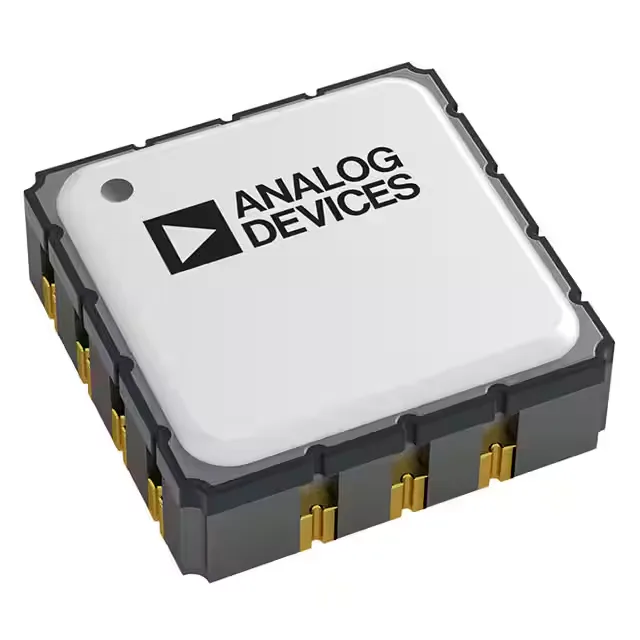
Analog Devices ADXL356BEZ — Discrete Semiconductors

ADXL356BEZ Analog Accelerometer, X/Y/Z, ±10g/±20g, 14-CLCC

MPNADXL356BEZ
End of Life

Analog Devices ADXL356BEZ, triple-axis analog accelerometer, X, Y, Z, ±10g / ±20g selectable range, 40 to 80 mV/g sensitivity, 1 Hz to 1 kHz bandwidth, 2.25 V to 3.6 V supply, -40°C to 125°C, 14-CLCC (6x6) surface-mount package, tray.

$79.7Ref. price · indicative, final on quote
Packaging14-CLCC
StockContact for availability
MOQ1 pcs
  • 100% new & originalTraceable channels only — no refurbs, no pulls, no remarked parts.
  • Date & lot codes on quoteStated per line before you commit; label photos on request.
  • MSL-compliant ESD packingMoisture-sealed bags with indicator cards; reels photo-verified.
  • PayPal buyer protectionPay by T/T, PayPal or Payoneer — card payments covered end to end.

Specifications

ADXL356BEZ Technical Specifications
ParameterValue
TypeAnalog
Output typeAnalog Voltage
Mounting typeSurface Mount
Voltage2.25V ~ 3.6V
Operating temperature-40°C ~ 125°C (TA)
Bandwidth1Hz ~ 1kHz
AxisX, Y, Z
PackageTray
FeaturesAdjustable Bandwidth, Selectable Scale
Case14-CLCC
Acceleration range±10g, ±20g
Sensitivity (mV (g))40 (±20g) ~ 80 (±10g)

Product details

What the ADXL356BEZ is and where it fits

The ADXL356BEZ is a triple-axis analog accelerometer from Analog Devices that outputs X, Y, and Z acceleration as analog voltage signals. It offers a selectable full-scale range of ±10g or ±20g, with corresponding sensitivities of 80 mV/g and 40 mV/g. The bandwidth is adjustable from 1 Hz to 1 kHz via external capacitors, letting you trade noise filtering against response time. Operating from 2.25 V to 3.6 V and rated from -40°C to 125°C, it's built for industrial vibration monitoring, structural health sensing, and inertial measurement in harsh environments.

Package and mounting

Housed in a 14-CLCC ceramic package measuring 6x6 mm, this is a surface-mount part with a hermetic seal — good for humidity and corrosive atmospheres.

Package and mounting

The ±10g range gives you 80 mV/g sensitivity — better signal-to-noise for low-amplitude vibration measurements like bearing wear or fan imbalance. Switch to ±20g (40 mV/g) when you're expecting shocks or higher-g events like impact testing or vehicle dynamics. The bandwidth adjustment is done with a capacitor on the output pin: a 1 kHz corner captures fast transients but passes more noise; dropping to 1 Hz cleans up the signal for steady-state tilt or low-frequency structural monitoring. No internal filter — the external cap is your only low-pass, so plan the PCB layout to keep the cap close and the trace short.

Lifecycle and sourcing

The ADXL356BEZ carries an Active product status and is ROHS3 compliant.

Frequently asked questions

What is the difference between ADXL356BEZ and ADXL357?

The ADXL356BEZ outputs analog voltage, while the ADXL357BEZ-RL7 outputs digital data over I²C or SPI. The ADXL357 also supports a ±40g range in addition to ±10g and ±20g, with sensitivity expressed in LSB/g rather than mV/g. Both share the same supply range, temperature rating, and adjustable bandwidth. Choose the ADXL356BEZ if your ADC or control loop expects analog signals; pick the ADXL357 if you want a digital interface and on-chip filtering.

Does ADXL356BEZ have a built-in filter?

No, the ADXL356BEZ does not include an internal low-pass filter. The bandwidth is adjustable from 1 Hz to 1 kHz by adding an external capacitor on the output pin. This lets you set the corner frequency for your application, but requires a capacitor on the PCB.

Is ADXL356BEZ compatible with 5V systems?

No, the supply voltage range is 2.25 V to 3.6 V. Running it from a 5 V rail exceeds the rated maximum. For 5 V systems, use a 3.3 V regulator for the accelerometer and level-shift the analog outputs if needed.

What is the closest functional second-source for ADXL356BEZ?

The ADXL356CEZ is the same triple-axis analog accelerometer with the same ±10g/±20g range, 1 Hz to 1 kHz bandwidth, supply range, and temperature rating. The only difference is the CEZ suffix — both are active and pin-compatible. For dual-sourcing, the CEZ is a direct alternate.