Dual-axis analog output — what the ±2g range and 312 mV/g mean for the measurement chain
The ADXL202JQC-REEL: This is a dual-axis (X, Y) analog accelerometer from the iMEMS family — the output is an analog voltage ratiometric to the 5.25 V supply, so the g-level scales directly: 312 mV per g of acceleration, centered at roughly Vcc/2 at 0g. The ±2g full-scale range covers tilt sensing up to ±90° (where 1g = 9.8 m/s²) and moderate vibration monitoring — the 312 mV/g sensitivity gives 624 mV span from -2g to +2g, which a 10-bit ADC on a 5 V reference resolves to about 4.9 mV per LSB, or roughly 16 mg per count.
Bandwidth and filtering — setting the response time for the application
Bandwidth is adjustable from 0.01 Hz to 5 kHz via an external capacitor per axis — this sets the measurement response time and the noise bandwidth. A 0.1 µF cap gives roughly 50 Hz bandwidth, suitable for tilt sensing; a 0.0022 µF cap pushes it toward 5 kHz for vibration capture. The on-chip selectable low-pass filter reduces high-frequency noise before the output buffer — critical for low-g measurements where the signal-to-noise ratio is tight at the 312 mV/g scale.
Package and temperature grade — commercial range, ceramic seal
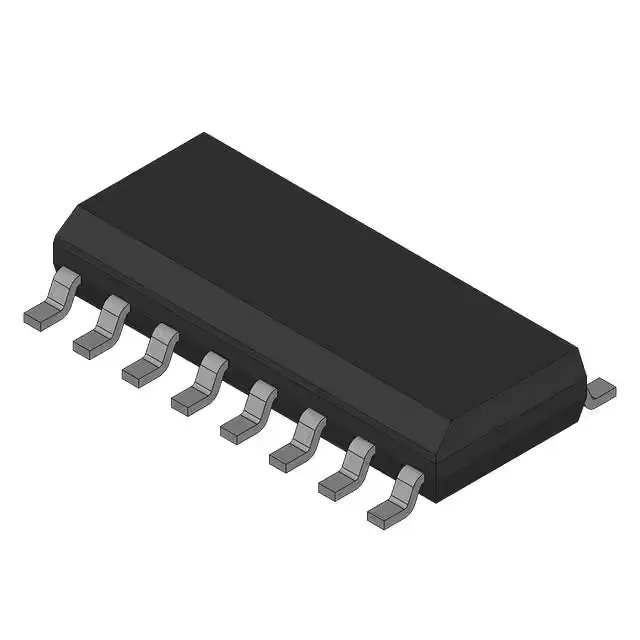
Housed in a 14-lead CSOIC with a 7.50 mm body width and a ceramic lid (CERPAK supplier device package) — the hermetic seal protects the MEMS sensor element from moisture and particulate contamination, which matters for long-term stability in non-condensing indoor environments. Not qualified for automotive or industrial extended-temperature applications where -40°C to +125°C parts like the ADXL203CE would be required.