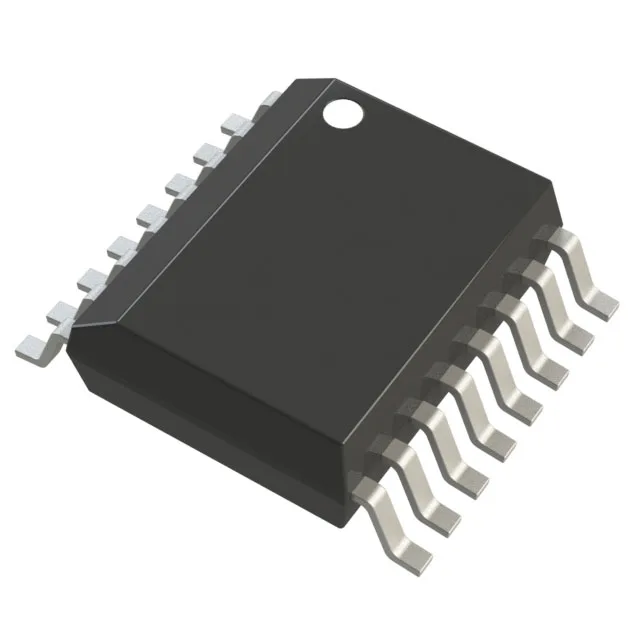
Four-channel unidirectional isolator for 1 Mbps signal paths
All four channels are unidirectional with inputs on side 1 only, making it a straight downstream isolator for MCU-to-peripheral or sensor-to-controller links.
1 Mbps data rate and 75 ns propagation delay — timing budget for the bus
At 1 Mbps the bit period is 1 µs, and the 75 ns propagation delay consumes 7.5% of that window. That leaves 92.5% for cable delay, receiver setup, and clock jitter — comfortable for most board-level isolation but worth checking if the link runs through long cables or multiple isolators in series. The 25 ns pulse-width distortion means the on-time and off-time differ by at most 25 ns, which matters for PWM or duty-cycle-sensitive signals.
1000 Vrms isolation and 15 kV/µs CMTI — where it fits
The 1000 Vrms isolation rating is a basic single-insulation level, not reinforced or double insulation. It is suited for isolating low-voltage control signals within the same enclosure — separating a 3.3 V MCU from a 5 V sensor, or breaking ground loops between two PCB sections. The 15 kV/µs common-mode transient immunity (minimum) keeps data intact when fast voltage transients slam across the barrier, which is the typical failure mode in motor drives, inverters, and switching power supplies.
The 105°C upper limit is the junction temperature; ambient plus self-heating from the 1 Mbps switching current must stay under that.
Surface-mount only. The 1.27 mm pitch is standard for this footprint class and routes easily on two-layer boards.
ROHS3 compliant.