5000 Vrms isolation with onboard DC-DC — one chip replaces two
That means you get 5000 Vrms galvanic isolation for both data and power in a single 16-SOIC package, eliminating the separate isolated power module and its board area. It is a general-purpose isolator rated for 1 Mbps signaling, with unidirectional channels — one input on side 1, one output on side 2, and the reverse direction for the second channel (inputs - Side 1/Side 2: 1/1). Typical applications include industrial fieldbus isolation, motor-drive interface, medical equipment where reinforced insulation is required, and any isolated power-supply feedback loop where you want to shrink the BOM count.
At 1 Mbps the part handles SPI, UART, and general-purpose GPIO isolation comfortably. The propagation delay is 100 ns max in both directions, and pulse-width distortion is held to 40 ns max — tight enough to pass a 1 MHz clock without duty-cycle corruption. The rise and fall times are 2.5 ns typical, which keeps edge-rate induced ringing manageable if you keep the trace short.
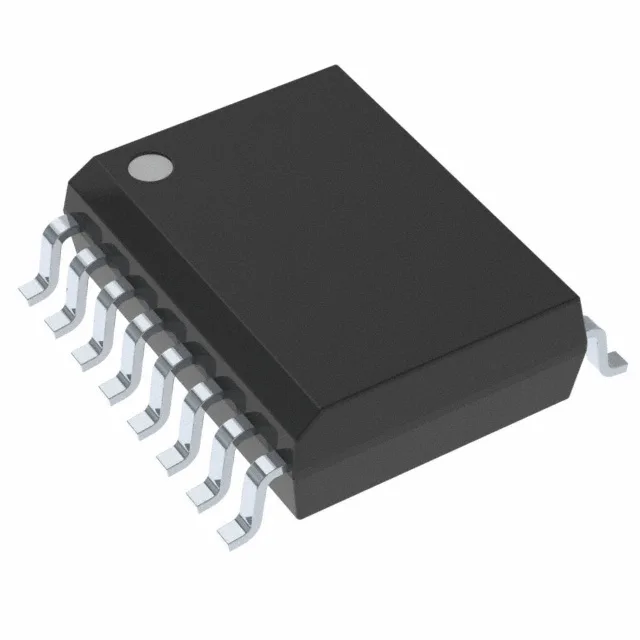
The 16-SOIC wide-body (7.50 mm width) package gives the creepage distance needed to sustain the 5000 Vrms rating — standard narrow SOIC would not pass.