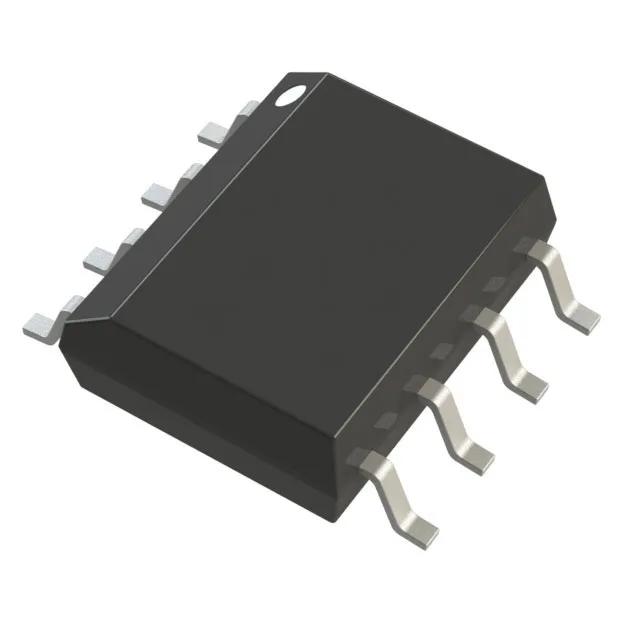
The ADUM5242ARZ-RL7 is a two-channel digital isolator from the Analog Devices IsoPower and iCoupler families. What sets it apart from a plain isolator is the integrated isolated DC-DC converter — it generates a regulated output voltage on the isolated side from the input supply, so you don't need a separate isolated power module. That makes it a space-saving pick for designs where you need to pass a couple of digital signals across a safety barrier and also power a small circuit on the far side. The magnetic coupling technology handles 2500Vrms isolation, and the 1Mbps data rate covers most control and status-signal applications. The two channels are unidirectional, both oriented from Side 1 to Side 2 (0 inputs on Side 1, 2 outputs on Side 2). This matters if you need bidirectional communication — you'd need a second device for the return path.
Isolation rating and what it buys you
The 2500Vrms isolation voltage is a reinforced-grade rating for basic insulation in mains-connected industrial equipment, medical devices (non-patient-contact), and power supplies. The 25kV/µs common-mode transient immunity means the output won't glitch when a motor drive or inverter switches at high dv/dt — a common failure mode in cheaper optocoupler-based isolators. Not automotive-qualified (no AEC-Q100 in the record), but suitable for many factory-floor and instrumentation roles.
Supply rails and the iso power output
The part needs two supply domains. Side 1 (the logic input side) runs from 2.7V to 4.0V. Side 2 (the output side with the integrated iso power) needs 4.5V to 5.5V. The dual-range supply means you can interface a 3.3V microcontroller on Side 1 while Side 2 runs from a 5V rail and generates the isolated output.
Timing specs for the bench
Propagation delay is 70ns max in both directions, with a 3ns max pulse-width distortion. Rise and fall times are 2.5ns typical. That 70ns is fine for a 1Mbps data stream (1µs bit period gives plenty of margin), but if you're daisy-chaining several isolators in a signal path, the accumulated delay might matter for timing-critical loops. The 3ns PWD means the output pulse width stays close to the input — good for PWM signals where duty cycle accuracy matters.
Housed in an 8-pin SOIC with 3.90mm body width (the narrow SOIC-8 footprint). Surface-mount only.
For production BOMs, this is a low-risk line item with no imminent obsolescence concern.