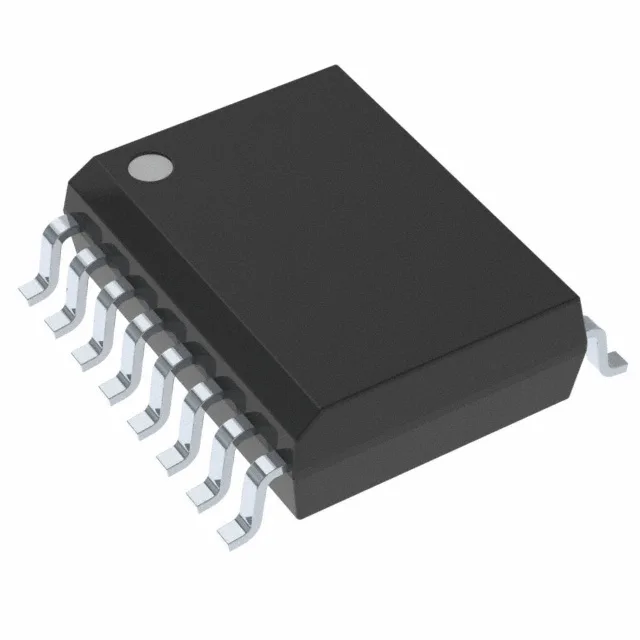
Two-channel digital isolator with onboard DC-DC — what it saves on the BOM
It delivers 2500 Vrms isolation and a 25 Mbps data rate across the isolation barrier, while the onboard power converter provides up to 150 mW of isolated output power — enough to bias an isolated sensor or a small ADC without a separate isolated supply module. The automotive-grade 'W' suffix qualifies it to AEC-Q100, and the wide-body 16-SOIC package (0.295" body width) gives the creepage distance needed for reinforced isolation in 48 V or 400 V battery systems.
2500 Vrms and 25 kV/µs CMTI — what they mean for motor-drive and inverter designs
The 2500 Vrms isolation rating is the baseline for reinforced isolation per IEC 60747-5-5 in industrial drives and automotive traction inverters. At 25 kV/µs minimum, this part handles the edge rates of a 10 kV/µs inverter with margin.
Automotive temperature range and supply rails
That means a single 5 V rail on the primary can generate a regulated 5 V on the isolated secondary — no extra regulator needed. The unidirectional channel configuration (0 inputs on side 1, 2 inputs on side 2) is set up for data flowing from the secondary to the primary side, typical for reading an isolated sensor or ADC.