Four channels, all one way — and that matters
The ADUM4400CRIZ is a four-channel, unidirectional digital isolator from Analog Devices' iCoupler series, using magnetic coupling to pass signals across a 5000 Vrms isolation barrier. All four inputs sit on Side 1, all four outputs on Side 2 — there is no reverse-direction channel. That makes it a straight drop-in for isolating a 4-bit parallel bus, SPI signals (SCLK, MOSI, MISO plus a chip-select), or four independent GPIO lines where the data flows one way only. The 90 Mbps data rate handles most high-speed fieldbuses and processor interfaces without stretching timing margins.
90 Mbps and 2.5 ns edges — budget your layout
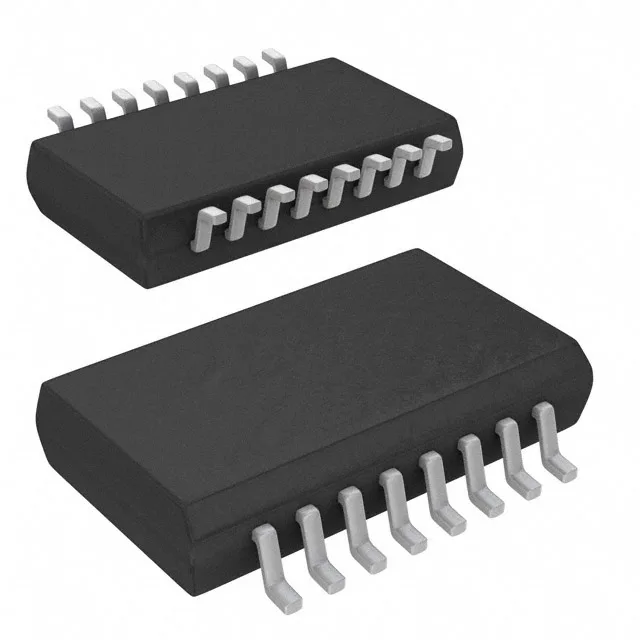
With 2.5 ns typical rise/fall times and a maximum propagation delay of 32 ns each way, this part is fast enough for 50 MHz clock isolation or a 90 Mbps serial link. The 2 ns maximum pulse-width distortion means the output pulse width stays close to the input — important for timing-sensitive protocols like PWM or encoder outputs. At these edge rates, the PCB layout matters: keep the isolation barrier clear of copper under the SOIC-16 body, and place decoupling capacitors close to each supply pin pair. The 16-SOIC wide-body (7.50 mm width) package gives enough creepage distance for the 5000 Vrms rating, but the rework tech will appreciate the visible pin 1 mark and the generous lead pitch.
25 kV/µs CMTI — stays clean in noisy environments
Fast-switching IGBTs and SiC FETs can slam several thousand volts per microsecond across the barrier; a part with lower CMTI would glitch or latch. The iCoupler magnetic-coupling architecture handles this well, and the 25 kV/µs figure gives comfortable margin for most industrial inverter designs.
Supply range and temperature — one rail covers both sides
The ROHS3 compliance means no exemption-laden materials; fine for RoHS-driven BOMs.
For a production BOM, this part carries no imminent obsolescence risk. The ROHS3 compliance is confirmed on the label and the datasheet.