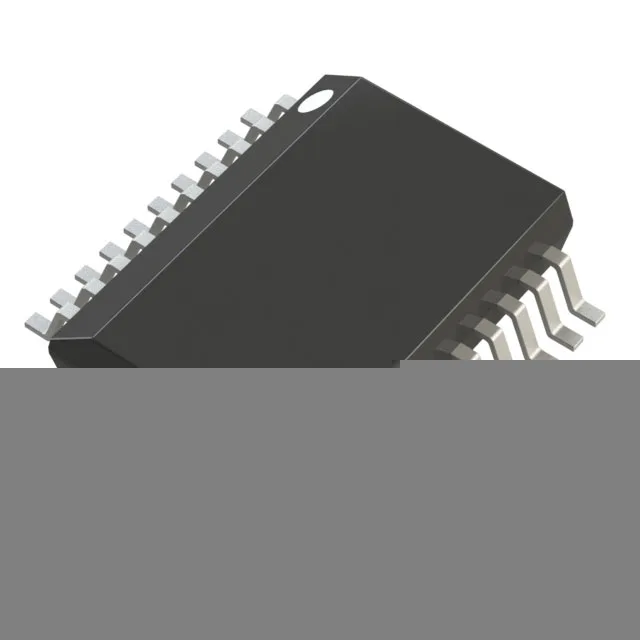
Four-channel unidirectional isolation in a 20-SSOP
The ADUM3482BRSZ-RL7 is a 4-channel unidirectional digital isolator from the iCoupler series, built on Analog Devices' magnetic coupling technology. It delivers 3750 Vrms isolation across a 20-SSOP package, with a 2/2 input-to-output channel split that maps directly to isolating a 4-wire SPI bus or two independent bidirectional signal pairs.
25 Mbps data rate and 33 ns propagation delay — timing budget for the isolation path
The 25 Mbps data rate and 33 ns max propagation delay (tpLH / tpHL) set the timing budget for the isolation path. At 25 Mbps the bit period is 40 ns, so the 33 ns delay leaves 7 ns of margin for the rest of the signal chain — enough for most SPI clock rates up to 12.5 MHz, but tight for a 20 MHz SPI bus. The 2.5 ns typical rise/fall time keeps the edges clean enough to avoid ringing on short PCB traces. Pulse-width distortion is spec'd at 3 ns max, which matters when the downstream logic expects a symmetrical duty cycle — think PWM signals feeding a gate driver or encoder output.
25 kV/µs CMTI — the motor-drive and inverter spec
Common-mode transient immunity of 25 kV/µs (minimum) is the rating that makes this part viable in systems with fast-switching SiC or GaN power stages. A motor-drive inverter switching at 20 kHz with 600 V bus edges can easily couple 10–15 kV/µs across the barrier; the ADUM3482BRSZ-RL7's 25 kV/µs floor gives headroom against false edge triggering or data corruption. If the system uses 1.2 kV SiC devices switching at 50+ kV/µs, you need to check the margin — the 25 kV/µs minimum is the datasheet guarantee, not a typical.
Supply rails and level translation
The 1.8 V minimum on Side 1 is the real differentiator versus older iCoupler parts that need at least 3 V on both sides. No isolated power on board — this is a signal isolator only. If the isolated side needs a local supply rail, budget for a separate isolated DC-DC converter or an iCoupler with integrated power (like the ADuM5xxx series).